The product judgment layer
for AI-built products.
Keep your existing tools. Pathmode connects team review with coding-agent work, carrying approved decisions into implementation and keeping the reasoning available for later requests.
One reviewed decision, available for the work that follows.
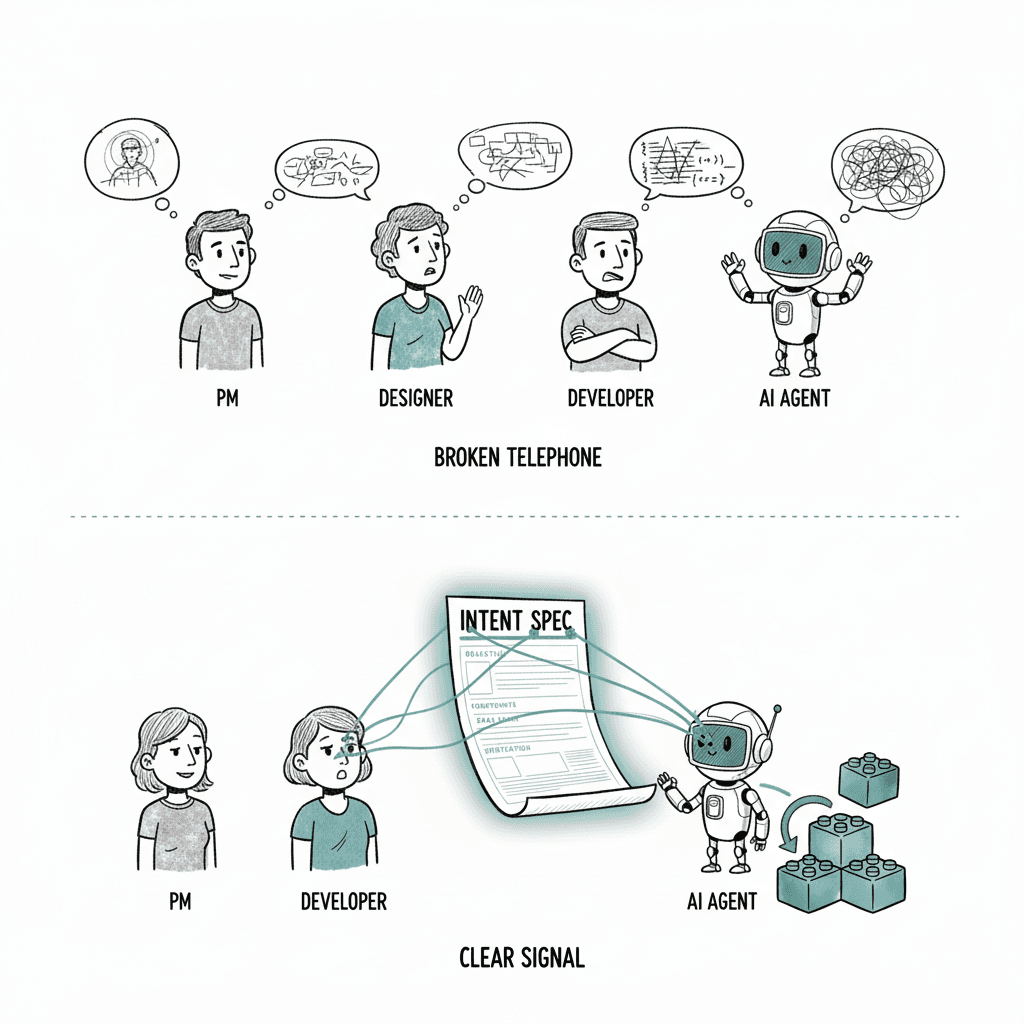
A different layer from the tools you already use
Keep your existing briefs, research, and engineering tools. Use Pathmode to review how the coding agent interprets a feature and record the proposal revision the product manager authorizes.
Review the interpretation of the ticket.
Keep your ticket as the original request. Have the repository agent propose the change, then let the product manager compare the proposed behavior with that request. Corrections return to the agent; the revised proposal comes back for authorization.
Read the full comparison →| Feature | Issue tracker workflow | Pathmode (judgment layer) |
|---|---|---|
| Starting point | Ticket or brief | Ticket plus the agent’s interpretation |
| Product review | Your team’s review process | Original request, correction, and applied revision |
| Implementation agreement | The agreed requirements in your workflow | Authorized intent.md in the repository |
Review the behavior behind the chosen feature.
Once the team chooses a feature, inspect how the coding agent interprets it. Pathmode gives the product manager a place to settle missing decisions and authorize a proposal with observable outcomes and clear boundaries.
Compare the workflows →| Feature | Roadmap workflow | Pathmode (judgment layer) |
|---|---|---|
| Team question | Which opportunity comes next? | Does this proposal express the intended change? |
| Starting material | Priorities and feature context | Chosen feature and original request |
| Next decision | Commit to a direction | Authorize the proposal revision |
Give the product manager a review they can act on.
A spec workflow can include requirements gathering, clarifying questions, and approval. Pathmode makes the product manager’s review of the repository agent’s proposal explicit: compare it with the original request, send corrections, inspect the applied revision, and authorize implementation.
Read the full comparison →| Feature | Spec workflow | Pathmode (judgment layer) |
|---|---|---|
| Proposal | Agent or human drafts the spec | Agent drafts from the request and repository |
| Review | Review in your existing tools | Product manager compares request and interpretation |
| Change | Revise the spec | Correction returned to the agent; applied revision reviewed |
Bring relevant evidence into the decision.
Keep research in the tools where your team works. Attach relevant findings when they help judge a proposal. Pathmode records which signals a person used to back a claim, while keeping assumptions and product choices visible.
| Feature | Research workflow | Pathmode (judgment layer) |
|---|---|---|
| Starting material | Interviews, observations, and findings | Relevant sources plus a feature proposal |
| Human judgment | Interpret the research | Use a reviewed signal to back a particular claim |
| Next action | Inform product choices | Correct and authorize the proposed behavior |
Carry workshop decisions into the proposal.
A workshop can produce a useful brief. Preserve that request when the coding agent proposes the feature, so participants can check whether their decisions survived the interpretation and correct what changed.
| Feature | Workshop workflow | Pathmode (judgment layer) |
|---|---|---|
| Working material | Shared ideas, diagrams, and decisions | Original request and proposed behaviors |
| Review | Discuss the direction together | Inspect the agent’s interpretation |
| Handoff | Share the workshop output | Authorize the revised repository intent |
Compare the review on a real feature
Planning and document tools can ask useful product questions too. Evaluate whether Pathmode’s explicit correction and authorization flow adds value to the process your team already uses.
Start from the brief you already have.
Document tools can bring in research, challenge assumptions, and share requirements with coding agents. Pathmode is worth evaluating when the next task is reviewing what the repository agent proposes to build and recording the product manager’s correction and authorization.
Pathmode and ChatPRD →| Feature | Document workflow | Pathmode (judgment layer) |
|---|---|---|
| Starting point | Draft or improve the product brief | Review the resulting agent proposal |
| Reviewer’s task | Clarify requirements in the document | Compare intended and proposed behavior |
| Decision record | Document and discussion history | Correction, applied revision, and authorization |
Check where the product decision is made.
Agents and product tools can already help with planning, review, and iteration. Compare your current process with one real proposal in Pathmode: can the product manager find the original request, correct a misunderstanding, and inspect the revision before the engineer builds?
See the worked review →| Feature | Your current agent workflow | Pathmode (judgment layer) |
|---|---|---|
| Original request | Where does the reviewer find it? | Attached beside the proposal |
| Correction | How does it reach the coding agent? | Request tied to the proposed behavior |
| Permission to build | Which revision did the owner agree to? | Explicit authorization of the proposal revision |
Browse by category
Compare Pathmode to entire categories of tools — not just specific products.
Pathmode vs. Spec-as-Contract Tools
Spec-driven workflows and product review before implementation
Pathmode vs. Issue Trackers
Execution tools: what's due, who's on it, and an agent that drafts the brief
Pathmode with plan mode
Already reviewing agent plans? See what a shared product review adds.
Compare to specific tools
See how Pathmode stacks up against individual products in your stack.
See it through your lens
The same surface reads differently depending on where you sit. Here's what Pathmode changes for each role.
Pathmode for Product Managers
When implementation gets cheap, the job becomes the bet, the constraint, the why.
Pathmode for Engineering Leaders
Quality used to be enforced at the pull request. Now it has to be enforced at the spec.
Pathmode for Designers & Researchers
Research stops living in a deck nobody re-reads — the evidence reaches the build.
Frequently Asked Questions
How does Pathmode fit with our issue tracker?
Do we need to replace our product tools?
How does Pathmode compare to ChatPRD?
Does Pathmode work with coding agents?
Do we need research before reviewing a proposal?
What do constitution rules do?
Can we try Pathmode locally?
Ask an AI
Still not sure Pathmode fits? Ask the AI you already use.
Each button opens that AI with the question filled in. It answers from what it can find online, much of it written by us, so check its sources before you rely on it.
Opens in a new tab.