
Changelog
Updates and improvements to Pathmode. We ship regularly.
September 28, 2026
Changed
- •Preflight grades intents written in Finnish. The objective, outcomes, title and constraint checks read Finnish wording as strictly as its English translation, so a Finnish spec no longer fails on its language alone. Other languages are still read but left unconfirmed (@pathmode/mcp-server 1.38.0, @pathmode/cli 2.7.0).
- •Preflight counts a refusal as a measurable outcome when it says which case is refused or what the refusal names: "An import with a duplicate ID is refused and names the existing row" now passes. A bare refusal such as "Bad requests are rejected" does not. Blocked and prevented follow the same rule, so "Bad requests are blocked" no longer passes either (@pathmode/mcp-server 1.38.0, @pathmode/cli 2.7.0).
September 27, 2026
Features
Your agent starts the connection, you approve it
npx @pathmode/mcp-server@latest adopt without a code. It prints a link and a short code. Open the link, check that the browser shows the same code, choose the workspace and Product, and approve. The agent collects the approval and uploads intent.md, so nobody copies an API key. Nothing is uploaded before you approve. If the workspace is at its key limit, the approval names the key it would replace, and Cancel changes nothing. The command generated in the browser still works (@pathmode/mcp-server 1.36.0).Changed
- •After you save an intent.md without a workspace, your agent points team review to adopt instead of the website and a manual API key. setup, the compile-intent prompt, and the Claude Code plugin say the same, and the plugin’s optional key can stay empty. An existing pm_live_ key still works for workspace access without a local intent (@pathmode/mcp-server 1.36.1, plugin 0.1.43).
- •Preflight reads a `## Why` section as the objective when there is no Objective or Problem section. A `## What` section is not read as outcomes, because it usually describes the solution. When outcomes are missing, the verdict says the What section was not evaluated and that success criteria belong under Outcomes (@pathmode/mcp-server 1.37.0, @pathmode/cli 2.6.0, plugin 0.1.44).
Fixed
- •Workspace editors can finish connecting a repository. The last step used to refuse them after the browser had generated their command.
- •If a connection response is lost, or a temporary server error interrupts adoption, rerunning adopt resumes the same connection. It keeps the saved credential and avoids creating another key or uploading the same spec twice (@pathmode/mcp-server 1.36.0).
- •setup stores your API key in a file only you can read, and checking the key no longer counts as using it. It refuses anything that is not a pm_live_ key before writing any config, including the settings placeholder, which used to report success (@pathmode/mcp-server 1.36.0).
- •Saving intent.md no longer deletes a Problem section written beside Objective, or a Proposed outcome beside Outcomes. Preflight reads only Objective or Outcomes when both are there, and the save used to treat the other section as spec and drop it without saying so. It is now kept, and the save message lists it. If the save leaves that field empty, the kept section would be read in its place, so the save removes it and names it (@pathmode/mcp-server 1.37.0, plugin 0.1.44).
- •Saving intent.md also keeps a prose Proposed outcome section when the file lists its outcomes in frontmatter. A list under that heading replaces the frontmatter outcomes; prose does not, so the prose is now kept as your text instead of being deleted (@pathmode/mcp-server 1.37.0, plugin 0.1.44).
- •The web preflight now treats an empty Objective, Problem or Outcomes heading the way the CLI does: the field stays empty instead of being filled from a Background or Summary section, so the same file gets the same verdict in both.
- •Preflight no longer calls an objective too vague when it found none. An intent.md with no objective section now gets "No objective found", and the vague message is kept for text it actually read (@pathmode/mcp-server 1.37.0, @pathmode/cli 2.6.0, plugin 0.1.44).
September 26, 2026
Features
Every check passed. Wrong duck.
Answer product choices without a workspace
A warning before an answer can fail the outcomes check
Changed
- •The Ask an AI section no longer calls its answer independent. The prompt is ours, and the answer draws largely on what we wrote. It stays on the comparison pages and is gone from pricing.
Fixed
- •Changing a choice from open to accepted in intent.md, with nothing else, no longer passes preflight. Without a workspace, an accepted choice counts only when the spec includes what it promised. This keeps the file consistent. It does not verify who decided (@pathmode/mcp-server 1.35.0, @pathmode/cli 2.5.0).
- •The preflight.pathmode.io paste box reads product choices, scope, and decisions. It used to call a spec with four open choices ready.
- •Decisions whose ruled-out text contains a closing parenthesis are no longer dropped when a local save rewrites intent.md (@pathmode/mcp-server 1.35.0).
- •Two accepted choices that promise the same outcome, edge case, or constraint add it to the spec once. It used to appear twice (@pathmode/mcp-server 1.35.2).
- •Without a workspace, the verdict no longer sends you to a proposal review you don’t have. It says a person answers or excludes each open choice before implementing. After a save, the note on connecting a workspace names what it adds: private evidence, a reviewer who answers and authorizes, and staleness across repositories (@pathmode/mcp-server 1.35.2, @pathmode/cli 2.5.2).
- •Answering a choice with its own recommendation, to reword an outcome the warning flagged, keeps the choice’s alternative. It used to replace the alternative with the answer, so the decision read as ruling out the option it chose. Same fix in the workspace review (@pathmode/mcp-server 1.35.3).
- •Intent.md writes from your agent run one at a time, so two answers sent together are both recorded. The second used to overwrite the first while both reported success (@pathmode/mcp-server 1.35.4).
- •Without a workspace, your agent reads intent.md from the repository your editor has open. It used to read the folder the MCP server was started in, so after switching checkouts it kept serving the old spec until the server was restarted (@pathmode/mcp-server 1.35.5).
Improvements
- •The pricing page starts with a choice between the keyless repository workflow and the Free workspace, and the first price shows without scrolling.
- •intentspec.org/intent-md checks an intent.md written in the format of Anthropic’s AI-native SDLC playbook: the verdict it gets as written, and the same file after three repairs. pathmode.io/intent-md redirects there.
- •intentspec.org documents the intent/<feature>/intent.md layout beside a root intent.md, and which one preflight reads.
- •The CLI and MCP READMEs open with a recorded first run you can reproduce with npx -y @pathmode/cli preflight.
September 25, 2026
Features
Green CI does not validate a test the same change edited
Check the build against the decisions you made
Preflight finds intent.md in an intent/ folder
intent/ folder, with spec.md beside it. When a repository has no intent.md at its root, preflight now reads intent/intent.md or intent/<feature>/intent.md. Only a file named intent.md counts, so spec.md is never graded as the intent. With several features, it asks which one to check instead of picking. A save writes back to the same file (@pathmode/mcp-server 1.34.0, @pathmode/cli 2.4.0).Mark a choice that doesn’t need a product decision
Changed
- •Green CI requires a complete changed-file list compared against the PR base commit IDs captured in its event. Runs without those IDs, including runs before a PR exists, leave checks held. A failed run still records failing checks.
- •The site navigation shows Log in and Sign up. Installation stays on the homepage and the Developers page.
- •Headings inside a field, such as a ## heading in implementation context, are written one level below the field’s own heading, so they stay part of it (@pathmode/mcp-server 1.34.0).
Removed
- •The full intent editor, including Open advanced editor. Intents open in the proposal view, and conversation continues in its discussion drawer.
Fixed
- •Changed claims no longer display evidence backing from an earlier revision while new records load or after a failed fetch.
- •An unrelated workspace folder no longer blocks a save to the repository being reviewed (@pathmode/mcp-server 1.34.0).
- •Undo in a brief no longer drops its decisions.
- •Onboarding recognizes when you are already signed in.
- •Invitation and membership changes complete as one step, so simultaneous requests can’t leave a workspace half-updated.
- •Saving a hand-written intent.md keeps the text under its title and every section Pathmode doesn’t read, such as Open questions. A save used to delete them (@pathmode/mcp-server 1.34.0).
- •A save writes only to the repository preflight checked, and never outside it, including through a symbolic link (@pathmode/mcp-server 1.34.0).
Improvements
- •Returning to a revised proposal starts with "What changed since your last decision", above the remaining choices.
- •Repository proposals wait briefly for review records before appearing, and same-content refreshes keep existing records on screen.
- •Cursor setup starts with a keyless configuration and Preflight. Connecting a workspace is a separate step.
- •Edit a claim in place on the proposal.
- •When verification blocks handoff, "Add a verification check" saves a repeatable check to run. Saving does not record a pass.
- •Blockers other than open choices are listed under the choices as "Also blocking handoff".
- •"Answer the open choice" brings that choice to the top of the page and marks it for a moment.
- •Invitation sign-up shows the invited email address and workspace.
- •check_intent_readiness takes repoRoot, so agents in clients without workspace roots, such as Cursor and Codex, can name their repository (@pathmode/mcp-server 1.32.0).
- •Preflight reads specs with "## Problem" and "## Proposed outcome" headings, with or without frontmatter (@pathmode/mcp-server 1.32.1, @pathmode/cli 2.3.1).
September 23, 2026
Features
Confirm or reject one claim in an agent’s proposal
Discuss a product choice before you answer it
Invite a new reviewer to one feature
Changed
- •The Intents board is now a searchable list.
- •New workspaces start from a brief.
- •Outcomes can be recorded only after an intent ships.
Removed
- •The Relationships view. Agents can still read relationships with analyze_intent_graph.
Fixed
- •Shipped or authorized intents no longer ask for authorization again.
- •Proposals with product choices now list their outcomes.
- •Opening repository setup no longer discards unfinished attempts elsewhere.
- •A brief that fails to draft is kept for manual editing.
- •Generated briefs with empty optional fields now save.
- •Your own brief is no longer marked as an agent suggestion.
- •Keeping a single suggestion no longer fails to save.
- •People who stay in onboarding now get the welcome email.
- •check_intent_readiness uses the intent you name when several folders contain an intent.md (@pathmode/mcp-server 1.31.2).
Improvements
- •The intent page shows one primary action, such as "Answer the open choice" or "Authorize as is".
- •Each action has one name. "Request changes" always goes to the repository agent.
- •The intent page states each fact once.
- •The selected product choice opens inside its own row.
- •Workspace home shows intents with unanswered product choices.
- •Unfinished briefs are kept in your browser and can be resumed from product home.
- •Repository setup is reachable from Settings, product home, and the product list.
- •Evidence items show their source, and "Add evidence" opens in place.
- •Intent rows show titles on up to two lines.
- •The developer docs start with the review workflow.
- •The About page lists key company facts.
September 20, 2026
Features
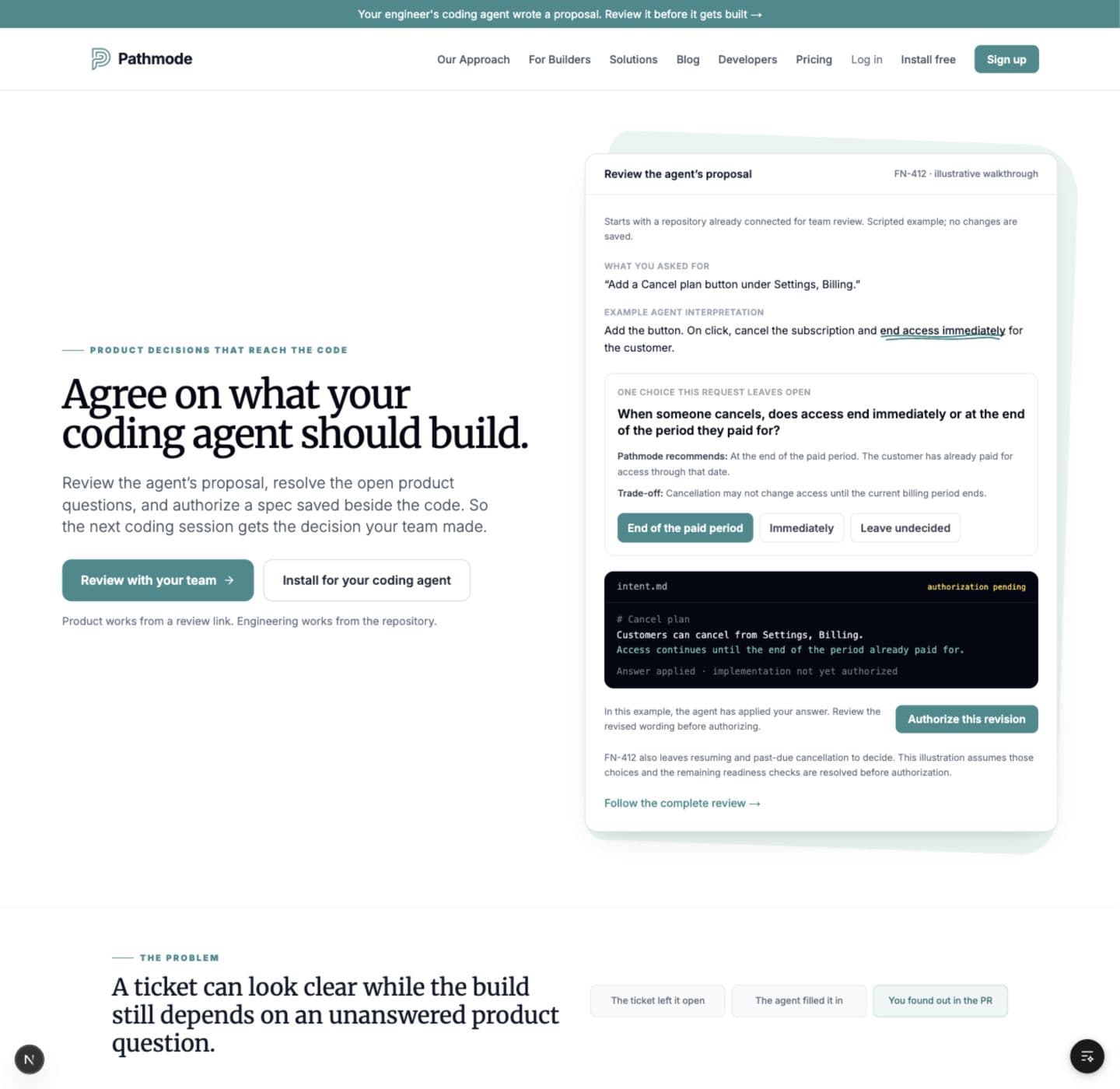
Answer product choices before authorizing the build
Follow a decision from the request to the next coding session
Fixed
- •Settled product choices no longer trigger a competing generated review question.
- •Prerequisite conflicts explain which decision needs attention instead of reporting a generic save failure.
- •Applied-choice summaries show the recorded answer instead of incorrectly reporting that product choices were removed.
Improvements
- •Repository reviews lead with the recorded problem and a numbered choice list showing dependencies, pending answers, and resolved decisions.
- •Advanced editing is available from More options, keeping proposal review as the default page.
September 13, 2026
Features
Review what the agent understood before it builds
Keep the original request beside the proposal
@pathmode/mcp-server 1.28.0 adds attach_original_request. Workspace editors can also attach the request directly from the review page. Attached requests arrive in the evidence inbox as unreviewed and do not count as evidence backing the proposal's claims.Share one feature with the teammate who decides on it
Invite the product manager as an editor
Fixed
- •If an agent cannot apply your correction, the review now shows why and who acts next. It tells you whether the agent can retry or you need to request the correction again against the current revision
- •Failed review analyses now say they could not be completed, instead of suggesting the proposal matches your request
- •A failed relationship rerun no longer shows its error beside "No new relationships found"
- •Invited teammates can create an account and return to their invitation without being asked to create a separate workspace
- •Linking evidence to a claim during review no longer blocks your coding agent from applying a correction
- •Requests attached by an agent now appear reliably in the proposal review. Retrying the same attachment does not create a duplicate
- •Failed evidence links now report an error instead of reporting success
- •Incomplete AI findings are rejected before they can be saved
Improvements
- •Reviewers share one question and recommendation per revision, so repeat visits use no additional AI allowance. Re-importing the ticket clears the outdated question
- •Correction fields start with the current wording. Choose "Use this wording" to adopt Pathmode's suggestion before sending
- •Review questions and recommendations use the language of your request. Suggested corrections use the language of the text they replace
- •Workspace home lists each intent by title, with its revision status underneath, making pending proposals easier to tell apart
- •When a discussion suggests a change that must go through your coding agent, you can open a correction with that wording directly from the notice
September 11, 2026
Features
Sign up with an email link
Name your workspace during signup
See when your coding agent is connected
Follow your teammate’s setup progress
Removed
- •New workspaces no longer include the fictional Acme HR product. Existing workspaces keep their sample content, and demos still include it
Fixed
- •Email signup links now open an existing Google account for that address instead of creating a duplicate
- •You can go back to correct your email address and request a link immediately for the corrected address
- •Invalid workspace names return you to the form with an explanation and your input preserved
- •Confirming signup in two tabs now opens the same workspace in both
- •The email confirmation screen now describes the signup path you chose
Improvements
- •The welcome email arrives after you confirm your address and explains how to get started in your workspace
- •The signup page keeps pricing visible and simplifies the steps before account creation
September 9, 2026
Features
Connect a repository as you get started
Invite a teammate to connect the agent
Try the readiness checks before signing up
Fixed
- •Signup works when the preceding decision did not name a product
- •The Pathmode logo on the preflight page now returns to the homepage
Improvements
- •Questions deliberately left open are distinguished from questions you have not reviewed, both in the review and the exported spec
- •Pre-signup decision reviews let you accept, edit, or leave each suggestion open individually
- •Continue from a product decision to signup and proposal review without a separate workspace step
- •Briefs record where in the product they were started
September 8, 2026
Features
Review a proposal from your agent
Review suggested additions
Authorize the revision your agent will use
Improvements
- •Workspace and Product Home prioritize proposals needing a decision, suggestions to review, and work waiting on an agent
- •Intent rows distinguish proposal review, suggestion review, revised proposals, and waiting for an agent from delivery status
- •The conversation editor remains available for discussion and detailed editing
- •Agent-written outcomes and edge cases retain their suggestion and evidence references through ordinary saves
September 3, 2026
Features
See what backs each claim
Keep evidence and assumptions distinct in handoffs
Review pull requests against the intent before merge
Keep private evidence out of committed files
Removed
- •The Evidence board’s Kanban, Flow, and Clusters layouts have been removed. The Inbox and evidence detail panel remain
- •Evidence Browse is now a flat, searchable list. Grouping, bulk selection, and Suggest intents have been removed; review claim backing on the intent itself
- •New evidence links in the signed-in UI must identify the claim they support. Existing general links remain visible, and API and MCP linking behavior is unchanged
Improvements
- •Evidence records distinguish human-reviewed items, imports awaiting review, and agent-created signals
- •Sample tickets and example cards are labeled as unverified assumptions
- •Paste text into the composer to extract and review signals inline; use the import dialog for files
August 31, 2026
Features
Connect an existing intent.md to Pathmode
Connect repositories to separate workspaces
Improvements
- •If repository adoption fails during a network step, you can resume without creating duplicate credentials
- •Adoption codes are single-use, expire after 15 minutes, and have rate-limited exchange attempts
August 30, 2026
Features
Use Pathmode with OpenSpec
Contribute to the IntentSpec standard
Read IntentSpec consistently across tools
Use the repository’s intent for local checks
Pass handoff notes to the next agent
See intent status when Claude Code starts
Fixed
- •The Engineering Lead and First Intent use case now opens the flow that works without an API key
- •Plugin installation instructions are consistent across the homepage, preflight, intent compiler, and developer docs
- •Page titles and blog metadata now describe their current content
August 29, 2026
Features
Import and export OpenSpec changes
Confirm readiness dimensions in your workspace
August 28, 2026
Fixed
- •Workspace readiness checks now read edge cases correctly, fixing a false failure for specs that already defined them. Current-intent reads and outcome rubric exports also include edge cases. Fixed in MCP server 1.14.1
August 26, 2026
Features
Bring code context from your agent into the spec
Link a pull request to verify the merged work
Save agent-created specs to your workspace
Fixed
- •Merged pull requests now update intents when a product has its own GitHub connection
- •A merge only updates intents associated with that repository
Improvements
- •Concurrent edits to a spec report a version conflict instead of silently overwriting each other
- •The new record_implementation_context MCP tool lets agents submit code context
August 23, 2026
Features
Try Preflight in your browser
Authorize agent proposals before implementation
Import a Linear or Jira backlog as evidence
Verify work against the pull request diff
Continue from a finished spec to agent handoff
Describe how the product works today
Removed
- •Creating GitHub Issues from intents has been removed. GitHub repository analysis and merge verification remain available, as do issue creation in Linear and Jira
Improvements
- •The setup checklist now includes connecting a repository for codebase analysis
- •Pasted customer quotes and measurements retain their types and source references
August 22, 2026
Features
Find agent-created specs awaiting your review
Measure outcomes after shipping
Record decisions directly in the spec
Tailor setup and interviews to your role
Install the Claude Code plugin
/plugin marketplace add pathmodeio/claude-plugin, then /plugin install pathmode@pathmode to install the MCP server and seven skills. Without an API key, specs stay in your local intent.md. Add a workspace key to use connected features; the key is stored in your OS keychain.Fixed
- •The shipped-status gate now recognizes verification checks created in the current editor
- •Unsubscribe links now require a valid signed token
- •Outcome measurements require a workspace writer role; viewers retain read access
Improvements
- •Connector imports now identify their integration source
- •The product setup checklist detects team and agent connections and closes when complete
- •Developer docs now include decisions and implementation-findings endpoints
August 21, 2026
Fixed
- •Installing without an API key now automatically starts local mode and exposes the tools that work with intent.md
- •Saving the same intent updates it; replacing a different intent requires an explicit overwrite
- •Reading intent.md now preserves multiline sections, scope, and decisions
- •The setup command now completes without an API key
June 21, 2026
Features
Draft your first intent before signup
Build product context from a document
Bring implementation findings back into the spec
Update repository instructions with sync_context
Fixed
- •Archived evidence is excluded from agent prompts and exports
Improvements
- •The landing-page draft asks a focused follow-up question to clarify a vague description
- •Product Home displays the strength of your product context
- •Pasting a substantial document during signup handoff starts extraction without asking you to paste it again
- •Pre-signup AI requests now use bot checks and rate limits
June 18, 2026
Features
Define scope and verification in IntentSpec v1.2
June 15, 2026
Features
Organize evidence by its properties
Import evidence from a remote MCP server
See which decisions need your attention
Edit a scanned workspace before signup
Let teammates join through their company email
Ask an AI about Pathmode
New essay: The Cost of Being Worth Using
Changed
- •The role-selection dialog no longer blocks the first workspace screen. Your role remains editable in Profile
- •Legacy /journey-map URLs redirect to /product-teams
Fixed
- •Atlassian and Jira integrations now verify installation bindings before resolving intents or assigning workspaces, preventing access across workspace boundaries
- •The Anonymization Firewall holds data back if redaction cannot complete
- •Google signup analytics now record correctly, and signup forms prevent duplicate submissions
- •Evidence suggestions no longer trigger an infinite render loop
- •A failed workspace load no longer sends you to workspace creation
Improvements
- •Settings and the Intents board use simpler controls and quieter styling
- •Creating a first product without a scan now opens its intent editor
- •New accounts derive a display name from the signup email
- •Account deletion now records an analytics event and notifies administrators
June 12, 2026
Features
Capture and review evidence inline
Edit evidence in place
Improvements
- •Empty products show sample signals you can adopt to get started
- •The evidence composer is available in List, Clusters, and Flow views
- •Single-line observations are automatically classified like longer pastes
June 8, 2026
Features
Explore advanced Playbook guides
Read developer docs generated from the API
Fixed
- •Health Metrics now appear in Markdown agent prompts as well as Claude Code and Cursor exports
- •Broken Get started links in Playbook guides now open onboarding
Improvements
- •Playbook guides include previous, next, and related links with clearer difficulty levels
- •Playbook, glossary, and comparison pages now explain Scope and Health Metrics alongside the other IntentSpec fields
June 6, 2026
Features
Explain and enforce workspace rules
See exactly what blocks readiness
Install agent skills and export an outcome rubric
npx @pathmode/mcp-server install-skills. The new outcome-rubric export turns your outcomes, constraints, edge cases, and checks into writer instructions and a separate grader rubric for Claude Managed Agents.Fixed
- •Intent conversations offer a retry when the AI fails
- •Saves no longer race between competing copies of the spec
- •Fast conversations no longer create duplicate specs, and autosave keeps each intent’s baseline separate
- •AI streaming preserves updates split across response chunks
- •Scope entered in conversation now appears correctly in the spec
- •Returning to a conversation phase no longer repeats the greeting
- •Demo requests submitted from the site are now saved correctly
Improvements
- •The Spec panel places the title and key properties above the document body
- •Constitution templates include enforcement levels and reasons for their rules
- •Site scans have stronger URL and network checks, more write operations are rate-limited, and integration webhooks reject replay attempts
- •Security updates cover dependencies and database permissions
May 27, 2026
Features
Include evidence in IntentSpec v1.1
Compare Pathmode with other tool categories
Fixed
- •Returning users reopen their existing workspace instead of creating a duplicate
- •Site scans no longer reject visitors solely because a bot-check script failed to load; rate limits remain in place
- •Reopening a spec no longer records past conversation turns as new activity, and autosave failures are tracked
Improvements
- •You can skip the site scan or continue without it after a scan fails. New workspaces still include sample content
- •Product pages now explain how evidence, decisions, and code context support work before and after shipping
May 25, 2026
Features
Ground a spec in your existing codebase
Include code context in agent handoffs
Choose a repository for each product
May 21, 2026
Features
Start a workspace from your website
Choose which product to scan
Describe your product when a scan cannot read it
Start your first intent from the product page
Changed
- •Public signup buttons and bookmarked signup links now open the site-scan flow
- •The sign-in dialog links new users to the same signup flow
- •Signing in without a workspace now opens site-scan onboarding
Removed
- •The previous first-run welcome panel has been replaced by site-scan onboarding
Improvements
- •The setup checklist reflects completed site scans and the next step of drafting an intent
- •A scanned description satisfies basic product setup; vision and north star can be added later
May 19, 2026
Features
Gemini 3.5 Flash for global workspaces
May 11, 2026
Features
Pathmode for Jira — Atlassian Marketplace
read:jira-work scope only.Push to Jira → linked from inside Jira
Bidirectional status sync
Atlassian Forge App workspace binding
Improvements
- •Privacy policy gained a dedicated section covering Atlassian integration data flows — what we receive (cloud id, site URL, issue keys, account IDs), what we send (intent summary + description on push), how we authenticate, where it is stored, retention, and uninstall behavior
- •New /support page with Pathmode for Jira–specific troubleshooting and security reporting contact
- •Jira Test Connection now works after Save — server-side test against stored credentials instead of requiring the user to re-type the API token
- •JiraIssueModal portals to document.body so it renders above the conversation panel in the Intent Editor
May 10, 2026
Features
AI Spec Review
Codex Integration Page
Use Cases Hub
Auto-Linked Glossary
AI Turn Rating
Workspace Ownership Transfer
Evidence Board 101 Playbook
Blog Subscribe
Changed
- •Robots.txt moved from static `public/robots.txt` to dynamic `app/robots.ts` — adds disallows for /api/, /intent/, demo, and review routes, references the sitemap
- •Dropped `offers` from SoftwareApplication structured data — Pathmode is SaaS, shopping-result fields do not apply
Removed
- •Legacy Figma plugin package (was drifting from the current intent model)
- •Legacy "Journey Mapping 101" playbook — replaced by Evidence Board 101
- •Standalone `ClaudeCodePage` component — replaced by the shared `AgentIntegrationPage` used by both /claude-code and /codex
Improvements
- •Spec Panel — Refactored, splitting execution hand-offs (Jira / Linear / Build Queue) and lifecycle controls (status, verification, review) into focused components. Smaller surface, fewer re-renders
- •Intent Quality scoring centralized in one library so the Spec Panel, AI Spec Review, and readiness checks all use the same rubric
- •Intent Interview JSON schema (with tests) replaces implicit field-name agreements between AI and client
- •Glossary entries now cross-link to each other and to core terms — a small built-in knowledge graph
- •New unified workspace integrations API across Jira, GitHub, Linear, and Slack with proper credential redaction
- •Workspace settings — new Rename and Export Context endpoints, plus tracking for conversation-fired AI guidance rules
- •Landing page hero, copy, and section structure tightened around "know what to build before you build it"
April 30, 2026
Features
First-Run Workspace Onboarding
Onboarding-Aware Intent Conversation
Improvements
- •Free plan now includes 3 editor seats (up from 1) — small teams can get started without hitting the paywall
- •Product creation now returns full metadata, allowing onboarding and analytics flows to tie created products to follow-up intents without extra lookups
- •Paid-plan CTAs open the in-app contact modal when billing is not enabled, keeping interested teams inside the Pathmode experience
- •Updated primary landing CTAs to "Start for free" and tightened homepage messaging
- •Simplified product demo animation state to reduce timer/state drift
- •Onboarding analytics across the full activation funnel — hero views, submissions, skips, first AI response, and first spec update
April 6, 2026
Features
Intent Readiness Scoring
Smarter Context Interviews
Agent Prompt Generation
Plan Changes & Team Management
Fixed
- •Billing status hook, checkout flow, and portal redirect issues across multiple plan types
Improvements
- •API Reliability — Rewrote intent API routes to share a single, tested handler layer with consistent validation
- •MCP Server — Expanded tool surface: enhanced local file reading, better intent compilation, improved export formatting
- •Context Health — Updated indicators so teams see at a glance which products have strong context and which need attention
March 29, 2026
Features
Functional Roles
Improvements
- •Role-aware onboarding now prompts first-time users to choose their lens from workspace home
- •Functional role selection is saved to the user profile and can be updated later in Profile Settings
- •Added database support for functional_role with a safe default and validation constraint
March 28, 2026
Features
Evidence Inbox
AI Intent Synthesis
Structured Outcomes
Intent Scope
Intent Engineering vs Context Engineering
Changed
- •Removed beta banner — header now shows "Pathmode has launched!" announcement
- •Restructured workspace settings with new API Keys tab
Improvements
- •MCP Server — Structured outcome support, live quality checking with explicit rubric, scope field support, product strategy in exports
- •Document View — Keyboard navigation in outcome lists, structured outcome rendering with priority labels, provenance view integration
- •Evidence Board — New Inbox and Sources layout modes, layout selection in sidebar sub-menu, triage status counts in badges
- •PostHog — Server-side event tracking with session and distinct ID headers
March 21, 2026
Features
Conversation-First Intent Editor
ThinkingQuality Scoring
Evidence-Anchored Specs
Changed
- •Legacy form-based editor available via ?mode=form query parameter; conversation-first is now default
Fixed
- •Intent editor save flow to properly persist spec updates and undo history
- •Navigation issues between intent editor and product home
Improvements
- •Intent Editor Performance — Consolidated state machine and reduced re-renders
- •UI Consistency — Spec panel uses workspace design system with gray tones and no decorative hover effects
March 14, 2026
Features
Constraints Document Discoverability
Improvements
- •Context Builder guardrails phase now includes a file upload button for constraints documents (PDF, DOCX, TXT, MD, CSV)
- •New Intent modal shows a tip about constraints documents when none is uploaded for the product
March 11, 2026
Features
Smarter, Faster AI Conversations
Fixed
- •AI would loop on the same topic or re-ask questions you already answered
- •Conversations could get stuck on "Thinking..." with no way to recover — retry options now appear on failure
March 9, 2026
Features
PostHog Analytics Integration
In-App Feedback System
Product Creation Onboarding Flow
Changed
- •Evidence Board redesign — Tabbed layout (Evidence / Sources), sort dropdown, more compact cards, dedicated "Suggest intent" button
- •Intent Editor spec panel widened from 480px to 560px for better readability
- •Product Home — Strategy section split into compact two-column card (Vision | North Star); tighter spacing throughout
- •Insights Digest — Renamed from "Signals Digest"; critical items now use amber highlights; "View all" links to Evidence
- •Hero demo — Streamlined from 7 steps to 6 (Signals step removed)
Removed
- •Entire Signals system — Views, hooks, services, API routes, cron job, MCP tools, Slack notifications, and all UI references
- •Glyphex analytics tracker — Replaced by PostHog
- •Outcome quality scoring — Removed per-outcome quality badges (Testable/Decent/Vague) from the Intent Editor
March 6, 2026
Features
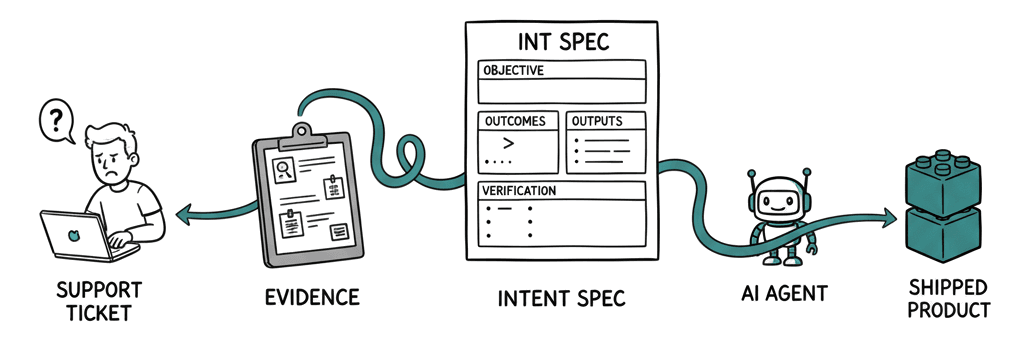
Hand-Drawn Illustrations
March 5, 2026
Features
Landing Page Refresh
Philosophy Page Rewrite
Improvements
- •Navigation link renamed from "Our Philosophy" to "Our Approach"
- •Hero demo now shows workspace vs. product sidebar modes
- •Each demo step includes a description bar explaining the screen
- •Removed unused IntentEngineDiagram and WhyHowWhenPositioning imports from landing page
March 3, 2026
Features
Gemini 3 Flash & Global AI Endpoint
March 1, 2026
Features
Living Specs — The Spec Lifecycle
Specs are now living documents. Every spec in Pathmode is grounded in evidence, reviewed by humans, consumed by agents, and improved by outcomes. This release closes the loop between what you plan, what you ship, and what actually happened.
Make specs feel alive — grounded in evidence, reviewed by humans, consumed by agents, and improved by outcomes. That's the loop that makes Pathmode indispensable.
Evidence-Anchored Specs
Spec Review with Evidence Backing
Reactive Signals
Agent Verification Loop
Improvements
- •Evidence freshness indicator on specs — shows amber warning when linked evidence is older than 30 days
- •Signal count badge in sidebar navigation
- •Verification score badges on Build Queue kanban cards
- •Verification failure signals with upsert dedup — re-running verification updates the signal instead of creating duplicates
- •Updated AI verification model from Gemini 2.0 Flash to Gemini 2.5 Flash
February 22, 2026
Features
Intent Compiler for Claude Code
intent.md to your project and optionally exports as .cursorrules or CLAUDE.md. No API key or signup needed.MCP Server v1.2 — Works Without API Key
compile-intent prompt, intent_save, intent_export) work entirely offline. Team features (dependency graphs, workspace strategy, governance) activate when you add an API key. Published to npm as @pathmode/mcp-server@1.2.2.Official MCP Registry Listing
io.github.pathmodeio/mcp-server. Anyone searching for intent engineering, spec building, or product development tools can now discover and install Pathmode directly.Intent Compiler Page
/intent-compiler marketing page with interactive terminal demo, tabbed output preview (intent.md / .cursorrules / CLAUDE.md), 30-second setup guide, and REPL-to-Runtime comparison showing how the free compiler connects to the full Pathmode platform.Improvements
- •MCP server README rewritten to lead with Intent Compiler and zero-config setup
- •API key changed from required to optional in manifest.json
- •Fixed pre-existing TypeScript error in MCP server api-client.ts
February 18, 2026
Features
Cursor Directory Listing
.cursorrules from real product context.February 17, 2026
Features
Integrations Hub
Google Analytics Integration
Zendesk Integration
GitHub Integration
Linear Integration
February 14, 2026
Features
Claude Code Integration Page
February 7, 2026
Features
Hero Animation as Video with Remotion
interpolate() calls — same JSX, same Tailwind, same SVGs. The result is a 37-second MP4 showing the full Pathmode workflow: Friction Inbox → Journey Map → AI Spec Generation → Export to Agent.Improvements
- •Added Remotion video rendering pipeline with preview and export scripts
- •Downloaded and bundled Inter and Merriweather fonts for server-side video rendering
February 6, 2026
Features
IntentSpec Open Standard
About Page
Philosophy & Product Demo
Playbook Guides
Export to Agent
Improvements
- •Landing Page: Redesigned hero section with interactive product demo and updated value proposition
- •Solutions Pages: Added solution-specific landing pages for Journey Management, Product Intent Infrastructure, and Enterprise
- •Footer: Added links to About, Philosophy, Playbook, and Comparison pages
- •Terms of Service: Updated publicity rights and terms
- •Intent Editor: Multiple stability and UX fixes across the spec editing workflow
- •Blog: Published new articles on intent-driven development and AI-native teams
- •Invitation Flow: Improved account handling and workspace invitation acceptance
February 1, 2026
Features
Intent Spec Workflow
January 29, 2026
Features
Inline Friction Highlighting
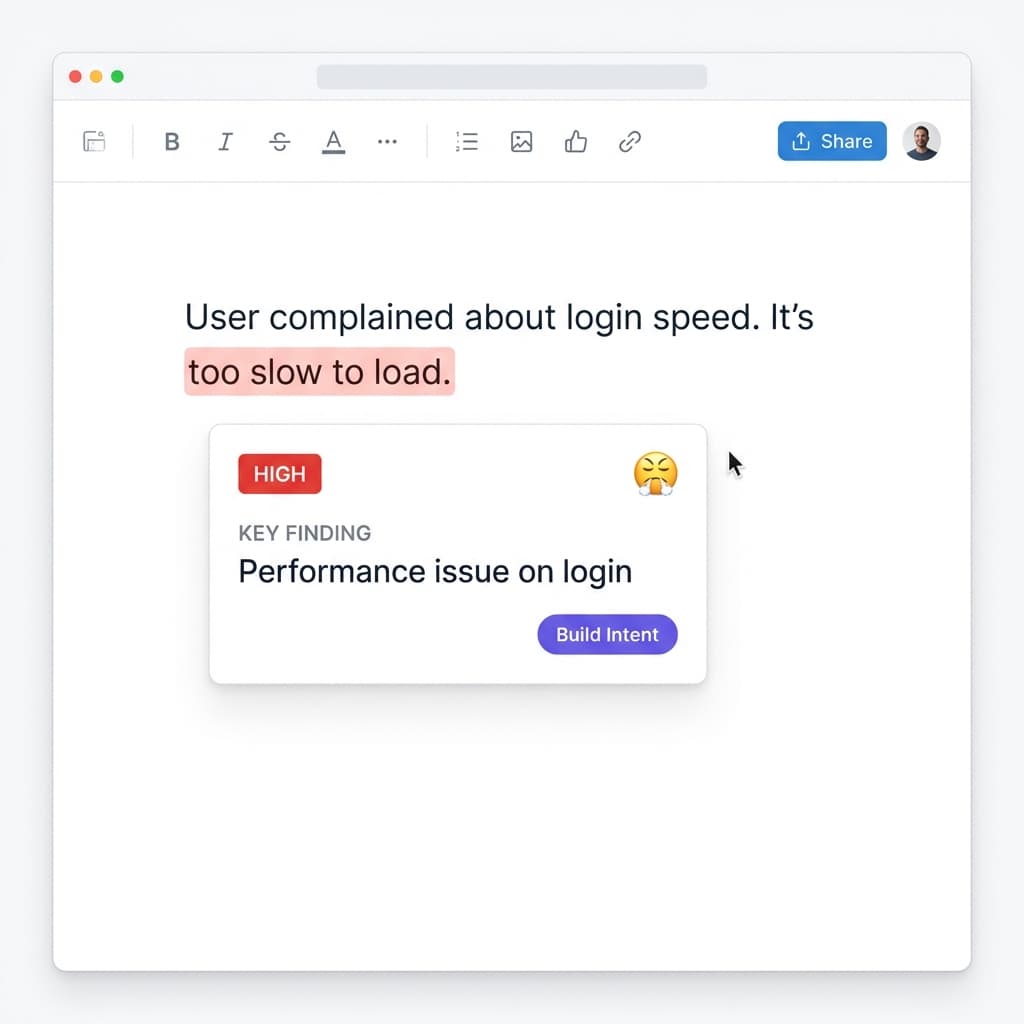
Document Highlighter Component
Improvements
- •Document View: Added read/edit toggle via eye/pencil icons
- •Friction Pipeline: Replaced "Specs Shipped" stat with "Evidence Docs" count
- •Interactions: Changed popovers to click-based triggering for better stability
- •Navigation: Fixed "View All Friction Points" button behavior
- •Persistence: Upgraded storage engine to support rich friction metadata (findings, tags)
January 26, 2026
Improvements
- •New Journey Experience: Redesigned modal to prioritize "Start from Friction" workflow
- •Journeys List: Refined list view layout to reduce visual noise
- •Welcome Email: Updated messaging to align with "Intent Layer" philosophy
- •Build Queue: Upgraded to Kanban board interface for better tracking
January 22, 2026
Features
Intent Graph
January 18, 2026
Features
From Journey Maps to Intent Layer
We started building Pathmode as a journey mapping tool. The vision was simple: help teams visualize customer experiences and connect user research to real workflows.
But as AI transformed how teams build software, we noticed something. Journey maps weren't just documentation—they were becoming the source of truth that AI agents needed to ship the right features. The map wasn't the output. It was the input.
Today, Pathmode is the Intent Layer for modern product teams. We don't just visualize journeys—we synthesize structured Intent Specs from real user friction, then push them to the tools that build. Cursor, Linear, Jira. The journey map is now a coordinate system for your entire product.
Intent is the new code. Specs are the new handoff. The map is the new constitution.
January 11, 2026
Improvements
- •Admin Notifications: Implemented email alerts for new sign-ups
- •UI/UX: Redesigned Blog Index page with responsive grid and author metadata
- •Architecture: Decomposed MainApp for Next.js App Router migration
- •Docs: Updated competitive landscape analysis
- •Fixed: Resolved modal navigation issues on public pages
January 8, 2026
Features
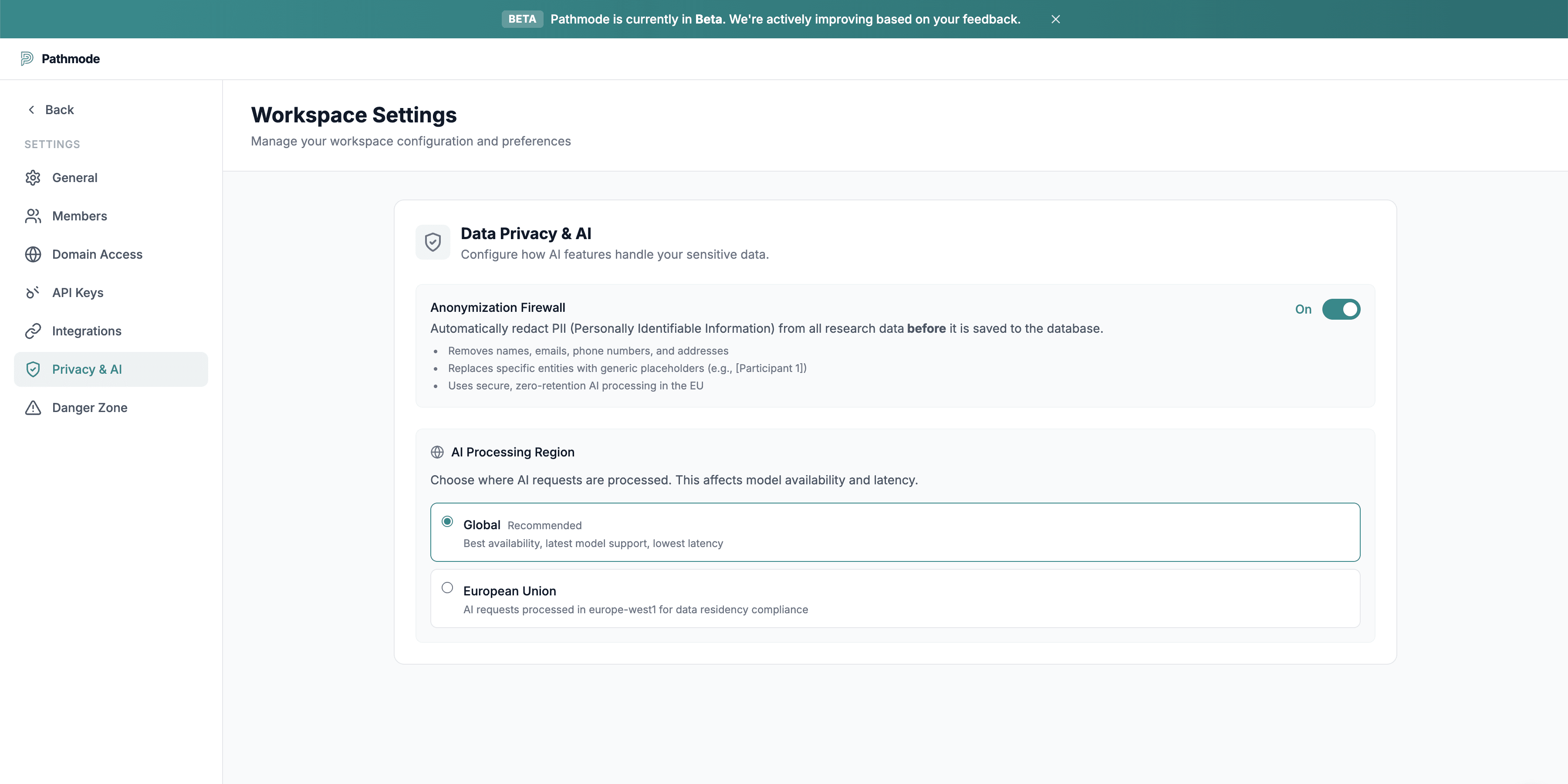
Anonymization Firewall
This feature uses a zero-retention AI pipeline to replace names, emails, and phone numbers with generic placeholders before data is ever saved to our database, ensuring full compliance with strict privacy requirements.
Improvements
- •Added PII detection toggle in workspace settings
- •Updated data ingestion pipeline with pre-processing hook
January 1, 2026
Features
Interactive Live Demos
Improvements
- •Smart Caching: Implemented intelligent local storage caching for public viewers, ensuring instant load times for AI artifacts like Storyboards and Proto Specs
- •Optimized Public View: Revised staleness detection logic to prioritize cached content for read-only users, preventing unnecessary regeneration loops
- •Robust AI Pipeline: Enhanced the generation engine with better payload management to reliably handle complex, data-heavy journey maps
December 29, 2025
Features
Integrations View & Live Embeds
Improvements
- •Added "Integrations" to main navigation
- •Added "Design Prototype" panel to Step properties for embedding support
December 28, 2025
Features
Specs View: Triage & Kanban
Redesigned the Feature Specs interface to split workflows into two distinct views:
- Triage View: Review and approve new opportunities.
- Kanban Board: Track specs from "Draft" to "Shipped".
Added an Archive workflow to hide deprecated or irrelevant specs.
Compact Research Dashboard
Hybrid Rendering Architecture
Improvements
- •Updated Research Dashboard visual hierarchy
- •Implemented `useAppNavigation` for consistent routing state
- •Resolved authentication race conditions with optimistic session hydration
- •Fixed session persistence issues on refresh
- • eliminated "Map Not Found" navigation errors
- •Resolved client-side hydration mismatches
- •Fixed React hook ordering stability issues
- •Centralized modal state management
December 26, 2025
Features
Brand Identity Update
Refined the logo for better legibility at small sizes. The new mark retains the spiral geometry with cleaner lines and balanced weight.


Improvements
- •Updated favicon and app icons across the platform
- •Unified spacing standards in navigation bars
December 25, 2025
Features
Feature Specs
Journey Editor Refinements
Improvements
- •Privacy Overhaul: Removed Google Tag Manager and installed privacy-first GA4 with strict cookie consent
- •Updated default workspace logo to use the Pathmode brand icon
- •Various performance tunings and layout fixes in the editor canvas
December 24, 2025
Features
New "Product Teams" Landing Page
Improvements
- •Updated front page tagline: "Stop managing journeys. Start building them."
- •Added new "For Product Teams" navigation link in footer
December 22, 2025
Features
Dynamic Hero Video
Improvements
- •Optimized landing page hero performance with video assets
December 21, 2025
Features
New "Pathmode vs The Rest" Comparison
Performance Tuning
Improvements
- •Fixed "zombie session" issue ensuring immediate and permanent sign-out
- •Cleaned up security section iconography on landing page
- •Updated site-wide navigation to new comparison breakdown
December 19, 2025
Features
Analysis Workbench
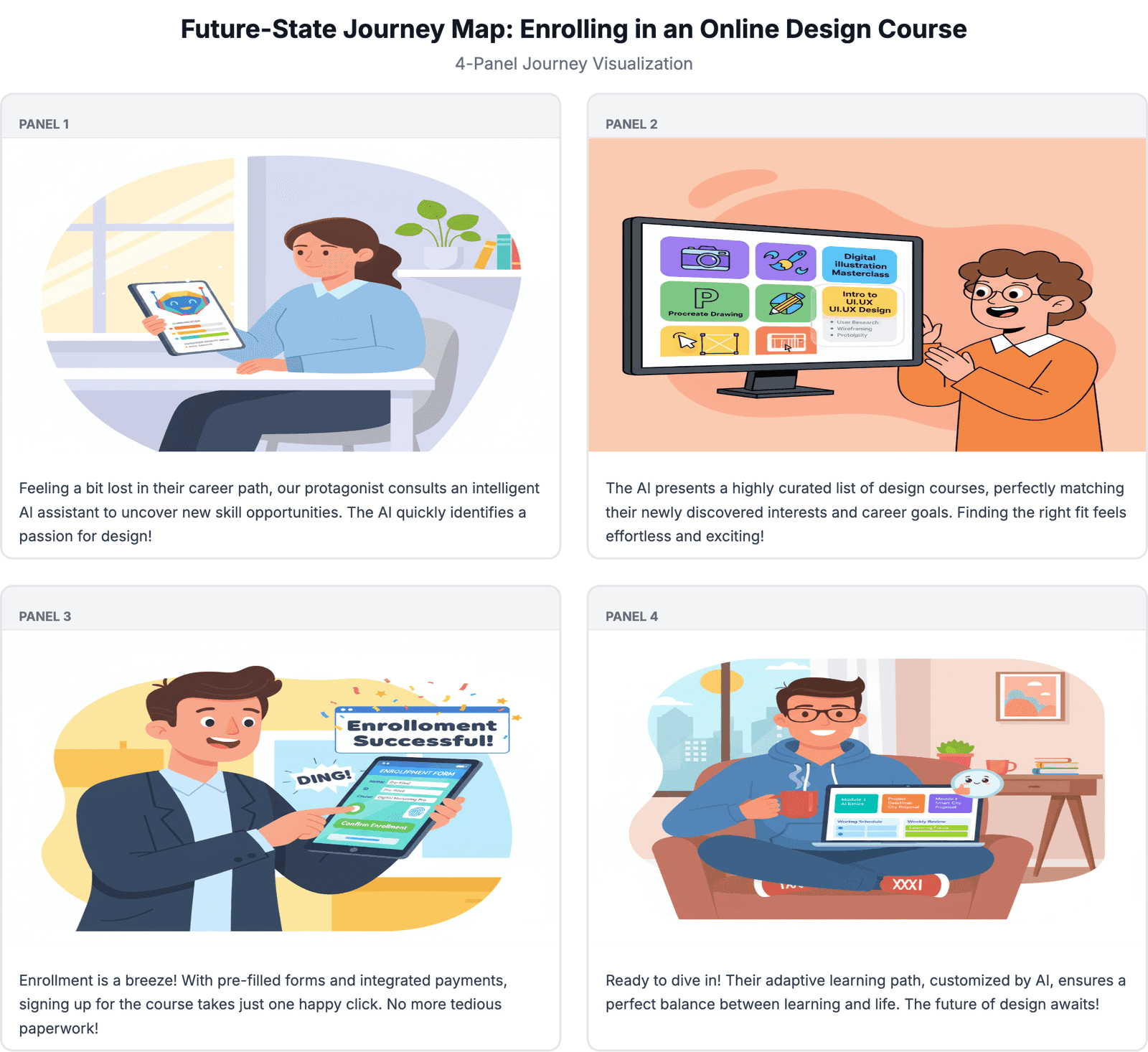
Vibrant Cartoon Storyboards
Improvements
- •Updated AI prompt to request "vibrant cartoon style" for storyboard panels
- •Enhanced image generation parameters for consistent flat design aesthetics
December 16, 2025
Features
Competitor Comparison Page
Improvements
- •Restored missing comparison page routing and functionality
- •Fixed an issue where the /compare link was resulting in a blank page
December 14, 2025
Features
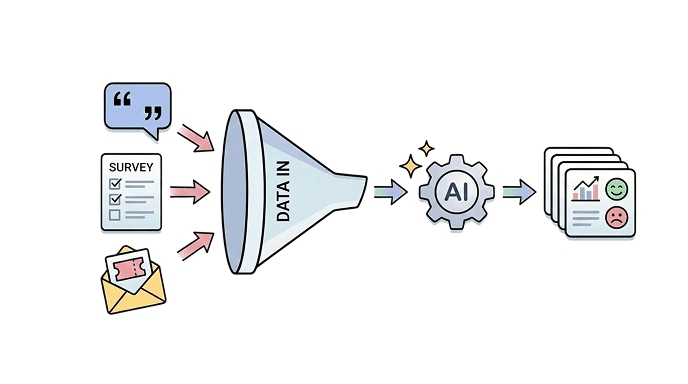
Redesigned Front Page with AI-Style Illustrations

Unified Design Workflow Visual Updates
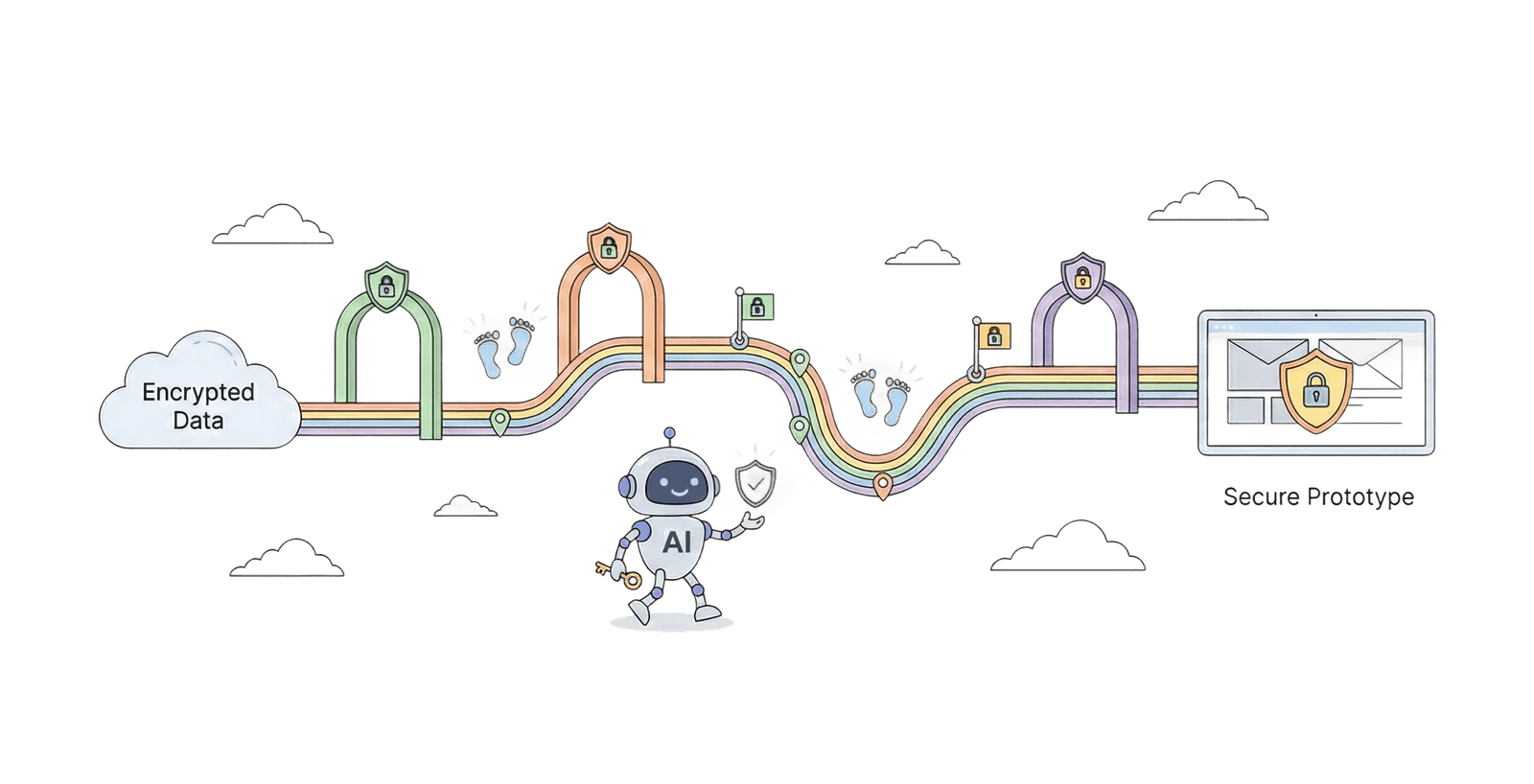
Enhanced Trust & Security Page
Dynamic CTA Section with Rotating Words
Improvements
- •Added pictograms to "The Problem We Solve" section: Research Silos, Design Chasm, and Costly Drift
- •Added workflow illustrations to all three steps in the "Unified Design Workflow" section
- •Redesigned Trust Center hero with security illustration and improved visual hierarchy
- •Improved visual consistency across landing page sections with flat, minimalist design
- •Enhanced image presentation with full-size pictograms that fill their container elements
- •Updated color scheme to use theme colors (subtle gradients) for better brand consistency
- •Added smooth word rotation animation to CTA section without layout shifts
December 13, 2025
Features
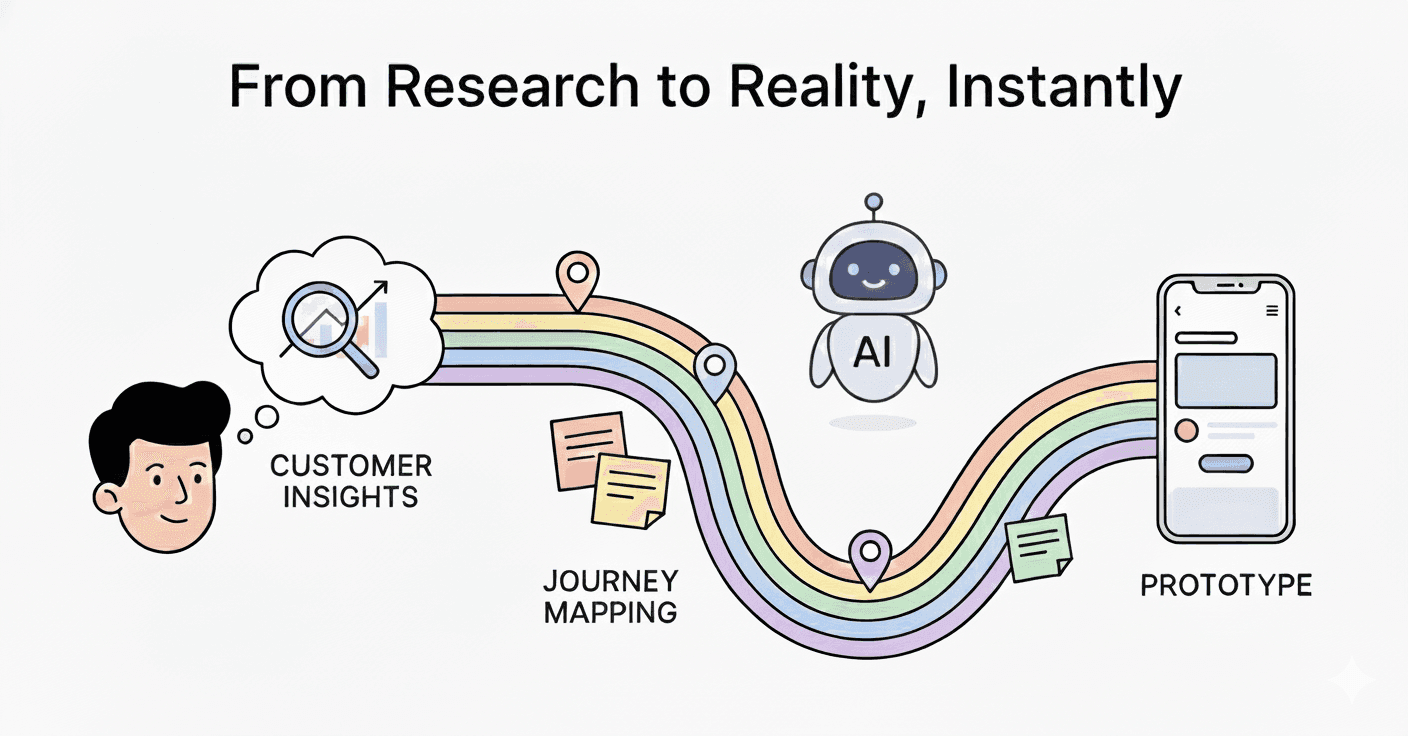
Enhanced Landing Page with Visual Journey Flow
Improvements
- •Improved visual communication of Pathmode's core value proposition on the front page
- •Streamlined image display to use a single, clear visual representation of the journey mapping process
December 12, 2025
Features
Improved Workspace Settings Access
Improvements
- •Moved workspace settings link from bottom navigation to header below workspace name
- •Settings now use workspace URL key format for consistent routing
- •Simplified "Back to Workspace" button to just "Back" in settings view
December 11, 2025
Features
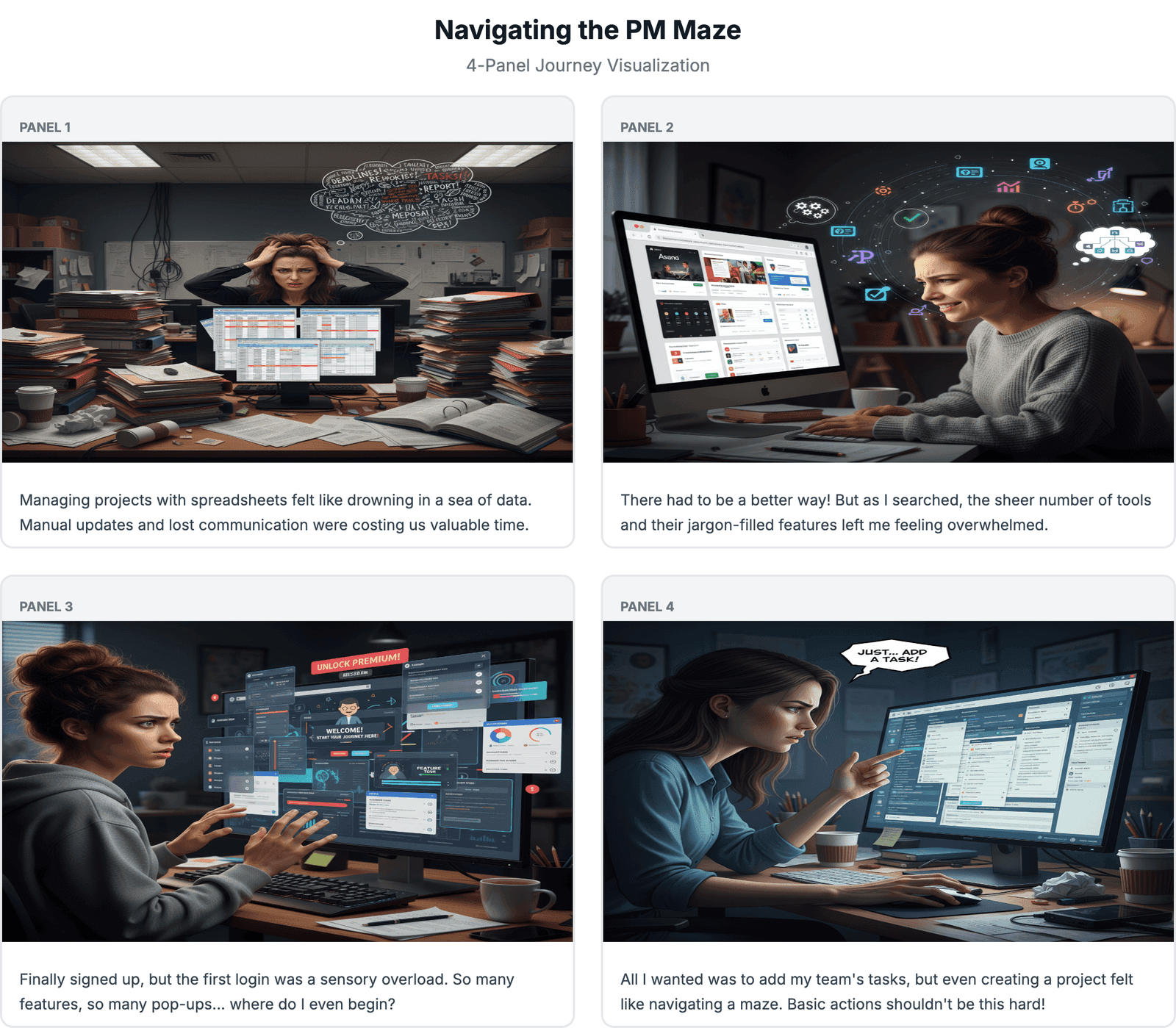
Enhanced Storyboard Generator with High-Quality AI Images
Improvements
- •Fixed image generation to properly extract images from API response structure
- •Improved image quality from SVG placeholders to high-resolution PNG images
- •Added authentication check - unauthenticated users see placeholder images with sign-up prompts
December 10, 2025
Improvements
- •Improved Google sign-in experience - you'll now see "Pathmode" when signing in with Google for a more professional and secure authentication process
December 8, 2025
Features
Workspace Settings Navigation
Improvements
- •Fixed Activity feed navigation link
- •Improved workspace invitation permissions - workspace owners can now create and manage invitations
- •Streamlined Users & Team view by removing redundant Settings button
- •Updated RLS policies to support workspace owner role for invitation management
December 6, 2025
Features
Trust & Security Center
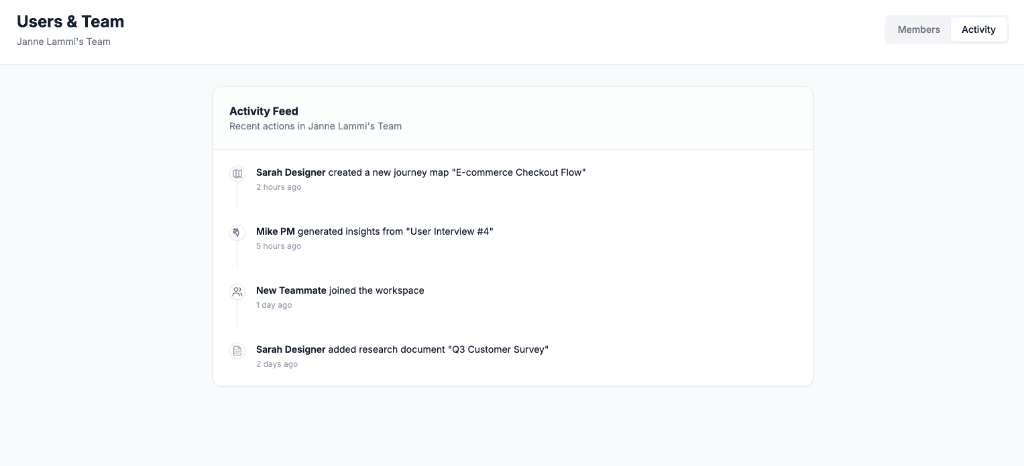
Team Management & Activity Feed
Cookie Consent Management
Improvements
- •Improved footer navigation across all pages
- •Enhanced landing page with security information
November 27, 2025
Features
Beta Launch
API Rate Limiting
GDPR Compliance
Profile Page
Performance Monitoring
Improvements
- •Enhanced security headers and Content Security Policy
- •Improved Trust & Security page with detailed compliance information
- •Added links to legal pages throughout the application
- •Launched changelog to keep users informed of updates
Want to stay updated? Visit our Trust & Security page for the latest on security and compliance.