
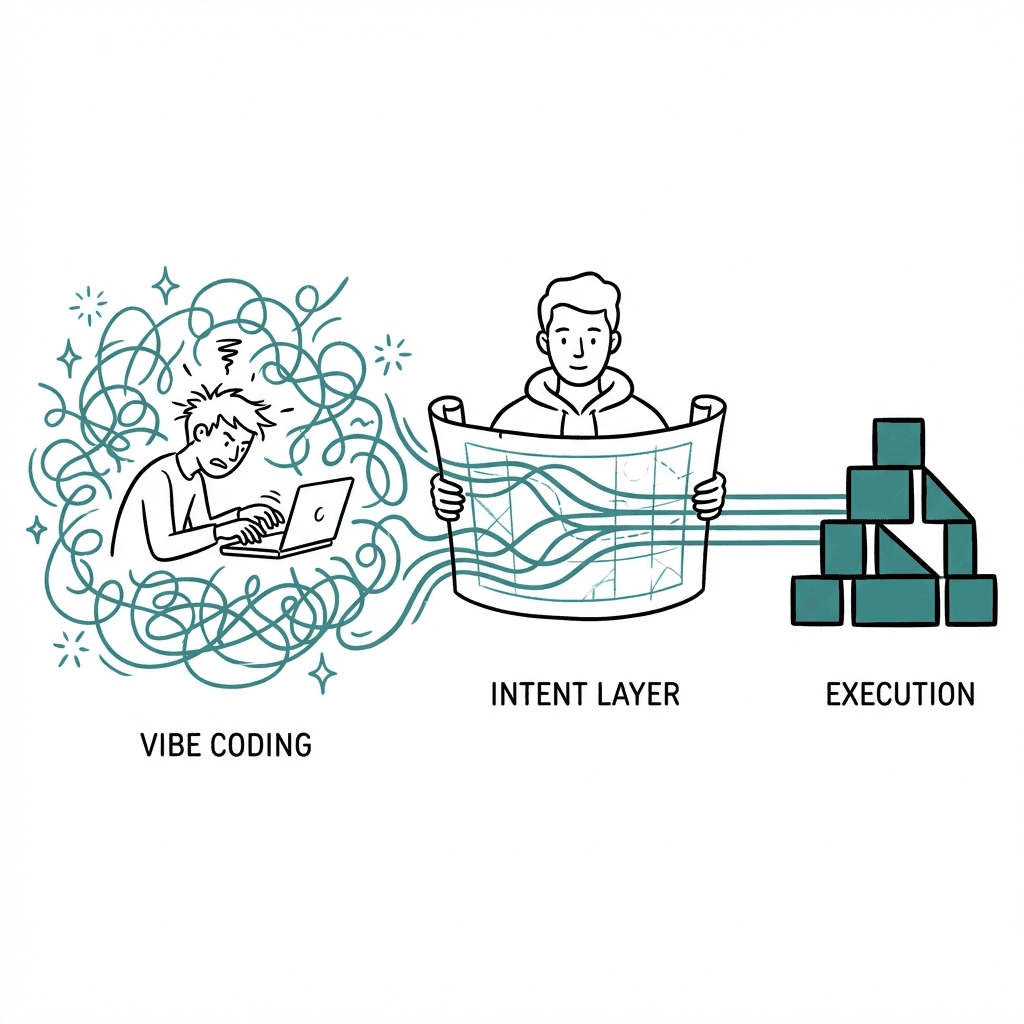
A founder I know shipped an entire SaaS product in a weekend. Cursor, Claude, a handful of prompts—the demo was stunning. Investors loved it. He hired two engineers to scale it.
Three weeks later, both engineers were ready to quit.
Not because the code didn't work. It worked fine—in the one scenario the founder had in his head when he prompted it. But nobody else could figure out what that scenario was. There were no specs. No architecture decisions. No record of why anything was built the way it was. Just 40,000 lines of AI-generated code that ran, but couldn't be explained, extended, or debugged by anyone who wasn't the original prompter.
He had a Vibe Coding Hangover.
What Vibe Coding Actually Is
Andrej Karpathy coined the term: you give in to the vibes, prompt your way forward, and accept code you don't fully understand. For a solo developer building a prototype, it's genuinely powerful. You move at the speed of thought. You skip the ceremony of specs and tickets and design reviews. You ship.
The problem isn't that vibe coding doesn't work. It's that it works just well enough to create a dangerous illusion: that what you built alone in a weekend is the same thing as a product.
It's not. A product has a second developer. A product has a PM asking "why did we build it this way?" A product has users hitting edge cases that nobody prompted for.
Vibe coding is optimized for the first commit. It has no answer for the hundredth.
The Two Illusions
Vibe coding creates two beliefs that feel true and aren't:
The Solo Illusion. "I can build anything in a weekend." You can build a demo in a weekend. A demo has one user, one path, and zero edge cases. The distance between a demo and a product is the distance between prompting and specifying—and teams discover this distance the hard way, usually around week four.
The Prompt Illusion. "I just need to prompt it better." This is the instinct when things go wrong: write longer prompts, add more context, be more precise. It helps marginally and misses the point. A prompt is a one-time request. It's ephemeral—typed once, consumed once, discarded. No matter how good your prompt is, it doesn't persist as a record of intent. The next developer, the next agent, the next sprint starts from zero.
Better prompts produce better code. They don't produce better products.
Where It Breaks
The hangover hits at the team boundary. Here's the pattern:
Week 1-2: A solo developer (or founder) ships fast. The codebase grows. Features appear. Everything feels like magic. The AI is an incredible pair programmer because the human holds all the context.
Week 3-4: A second developer joins. They open the codebase and start asking questions: Why does the checkout flow redirect here? What's this config flag for? Why are there three different auth patterns? The original developer answers from memory. This works, barely.
Week 5-6: A PM or designer joins and asks a different kind of question: Why did we build this feature instead of that one? What user problem does this solve? How do we know it's working? Nobody can answer. The prompts that generated the code are gone. The intent behind the decisions was never recorded—it lived in the vibe.
Week 7+: The team is reverse-engineering their own product. New features take longer than they should because nobody trusts the existing code. The AI agent keeps hallucinating solutions because it has no context beyond what's in the current prompt. Every change is a gamble.
The codebase becomes a black box. Not because the code is bad—AI-generated code is often clean. But clean code without recorded intent is a maze with no map. You can read every line and still not know where you are.
Why This Happens
The root cause isn't laziness or bad tooling. It's a structural mismatch.
Vibe coding collapses three distinct activities into one:
- Deciding what to build (intent)
- Specifying how it should work (design)
- Generating the code (execution)
When a solo developer prompts an AI, all three happen simultaneously in the prompt. The developer holds the intent in their head, the AI infers the design from the prompt, and code appears. It feels seamless because one person is the entire team.
But these are fundamentally different activities that require different artifacts. Intent needs to be recorded so others can understand why. Design needs to be structured so edge cases are explicit. Execution needs specifications so agents don't guess.
Vibe coding skips the first two and goes straight to three. The result is fast code with no lineage—software that works but can't explain itself.
The Shift: From Prompts to Intent
The cure isn't to stop using AI. It's to stop treating prompts as specifications.
A prompt is a request. An intent spec is a contract. The difference matters:
| Prompt | Intent Spec |
|---|---|
| "Add a checkout flow" | Objective, constraints, edge cases, success criteria |
| Typed once, discarded | Versioned, persistent, auditable |
| Invented by the developer | Derived from user friction |
| Optimized for speed | Optimized for correctness |
When a developer opens Cursor, they shouldn't be inventing context from scratch. They should be pulling from a system that already computed what needs to be built and why. When a second developer joins, they shouldn't be reverse-engineering the codebase—they should be reading the intent specs that generated it.
This is what we call the Intent Layer: a structured bridge between human goals and AI execution that persists alongside the code.
What the Cure Looks Like
Moving from vibe coding to intent engineering isn't about adding bureaucracy. It's about making the implicit explicit—before the agent starts generating code.
Capture friction, not features. The input isn't "what should we build?" It's "where does the user's experience break?" Support tickets, research transcripts, and analytics are raw material. Features are conclusions—and conclusions drawn without evidence are just vibes.
Structure intent before execution. An intent spec isn't a Google Doc. It's a structured artifact with explicit objectives, constraints, edge cases, and success criteria. Something a human can review and an agent can execute against. The spec is the product—not the code.
Make context persistent. Every spec should be traceable: why was this built, what friction does it address, what does success look like? When a new developer joins in week three, or a new agent picks up the task in sprint five, the context is there. Not in someone's head. Not in a deleted Slack thread. In the spec.
Verify against intent, not intuition. After shipping, the question isn't "does this feel right?" It's "did the friction decrease?" Measurable outcomes close the loop between what you intended and what you actually delivered.
The Diagnostic
You have a Vibe Coding Hangover if:
- New team members spend their first week asking "why" instead of building
- Your AI agent keeps generating code that technically works but misses the point
- Nobody can explain which user problem a feature solves without checking Slack history
- Your backlog is a list of features, not a map of user friction
- The founder is the only person who understands the architecture—and they explained it by narrating their original prompts
The hangover doesn't end by prompting harder. It ends by specifying clearly.
Intent is the cure. Structured, versioned, traceable to the friction that justified building in the first place.