
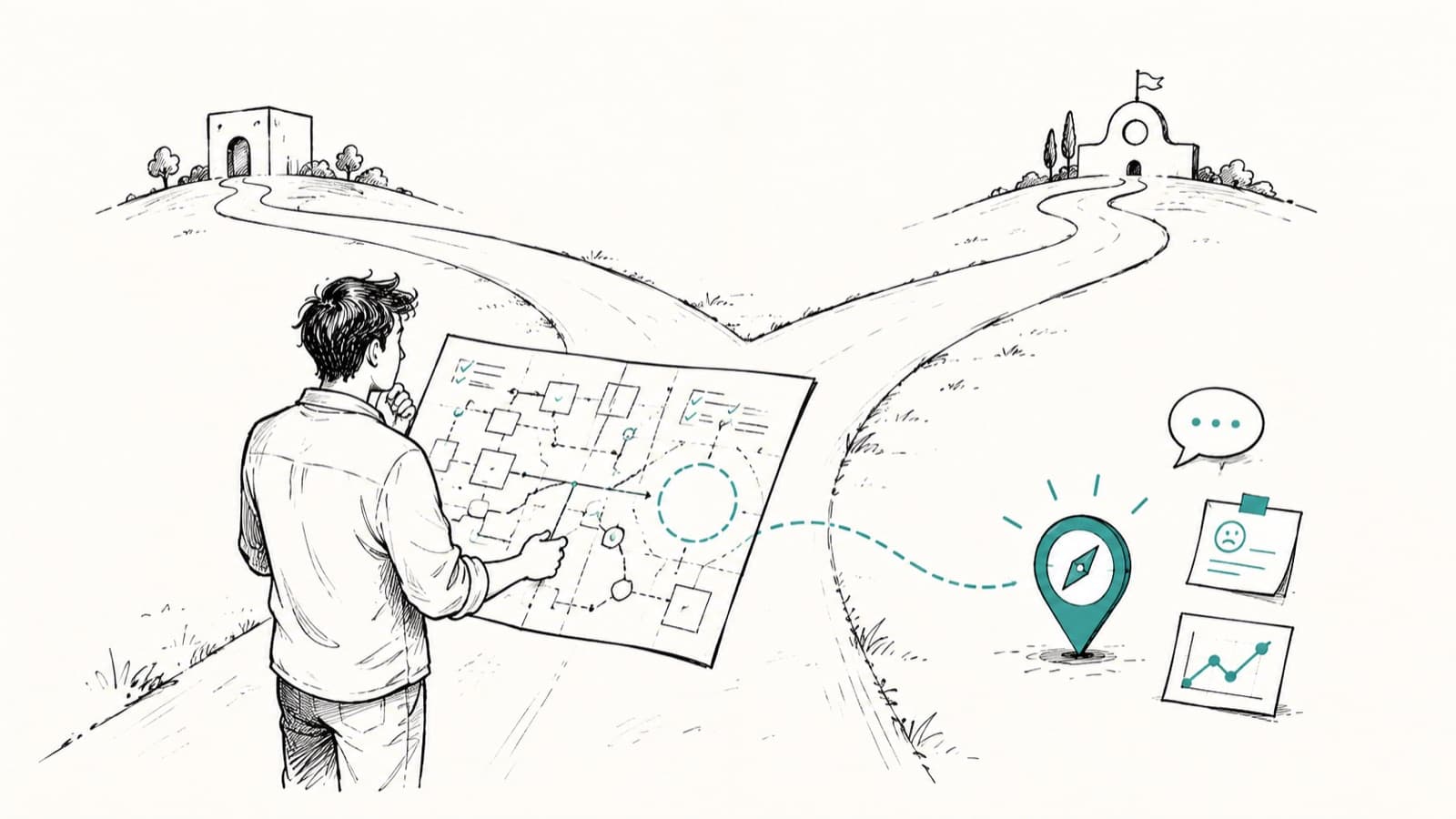
Updated September 13, 2026: revised the example around proposal review and narrowed the claims about what architecture and planning tools can establish.
Your agent has architecture. The product decision still needs a review.
Consider an illustrative checkout change. The request is “Help customers complete payment when processing is slow.” The agent proposes configurable retry counts in checkout/payment, with tests and changes contained to the existing module.
The proposal is technically plausible. But the product owner reads it and asks: “Are we trying to give customers control over retries, or help them understand whether their payment is still processing?”
That question can change the build before a line is written. The missing input is a product choice that the team has not yet agreed.
Structure is not judgment
An architecture model can explain where a module sits, what it owns, and which dependencies a change might affect. That helps an agent propose an implementation that fits the system.
It can also contain product context. A prompt, ticket, specification, or planning conversation can carry reasons and constraints too. There is no rule that reserves “why” for a separate tool.
The question is whether the proposed behavior has been checked against the intended behavior by the person responsible for the product decision. A clean diff and a well-documented architecture do not establish that agreement.
A build can be technically correct while the product decision remains unconfirmed.
Four inputs worth keeping together
- Where. Architecture, ownership, boundaries.
- What must hold. Contracts, tests, specified behavior.
- When. Task state, queue, priority.
- Why this change. The problem, the chosen approach, alternatives, and the evidence or assumptions behind the choice.
These inputs can share a document or live in different systems. What matters is whether the people and agents doing the work can find the current decision and understand its limits.
An evidence link can help explain a choice. An explicit hypothesis can also be a legitimate starting point. Neither an attached ticket nor a confidently written explanation establishes that a solution will work.
One proposal, one consequential question
Return to the checkout example. All observations and product context here are synthetic; this is a worked example, not a recorded comparison between tools.
The owner brings two pieces of context to the review: users in the illustrative sessions hesitated during a silent wait, and the payment provider can continue processing after the interface stops receiving a response. Those inputs suggest questions about feedback and payment state. They do not prove that another retry control will help.
The team considers three approaches:
- Expose retry settings. Gives customers more control, but asks them to understand a technical failure they may not be able to diagnose.
- Show processing status and reconcile the result. Tests whether clearer feedback helps, while treating an unknown payment result carefully.
- Replace the provider. Could address an underlying performance problem, but is a much larger change that needs its own investigation.
The owner chooses the second approach as the first experiment. The engineer checks the provider's behavior and helps define what can be implemented safely. The correction back to the agent is specific:
Show customers when payment is still processing. If the result is unknown, preserve that state and reconcile it with the provider before offering a retry. Keep the existing provider. Do not expose configurable retry counts. Any retry must preserve protection against duplicate charges.
The agent revises the proposal. The owner reviews that revision against the original request, resolves remaining product choices, and authorizes it before implementation. Sending the correction alone is not approval to build.
The agreed spec also names what would reopen the decision: if clearer feedback does not improve completion, investigate the underlying delay and the other approaches. Implementation checks can establish whether the specified behavior was built. Measurements afterward address whether the experiment helped customers.
Nothing in this example requires an agent to miss a question that only a human can notice. The question could come from the owner, engineer, or agent. The important event is the team resolving it and carrying the agreed answer into the build.
The decision needs to survive the conversation
A useful correction can still disappear into a thread. The owner explains the intended behavior, the engineer passes it along, and the agent builds from an earlier version of the proposal. Or someone returns next week and cannot tell whether “add retry settings” was agreed, rejected, or merely suggested.
The record needs to distinguish those states. Keep the original request, the proposed interpretation, the correction, and the revised proposal connected. Record who authorized which revision. When implementation uncovers a contradiction, bring it back to the decision instead of silently choosing a new product behavior.
The repository can hold the agreed decision in intent.md. Private research can stay elsewhere, with safe summaries and references available when needed. The person reviewing the product choice should not have to edit a repository file to participate.
Why not put it in the prompt?
You can. For a small change, a prompt and a careful review may be enough. Keeping a separate record earns its cost only if it helps the team recover the agreement and act on changes to it.
Three questions make that practical:
Who decides? Identify the person responsible for the behavior, while keeping engineering and other relevant judgment in the discussion.
Which version was agreed? A correction, a draft, and an authorization are different events. A material change to the proposal needs another review.
What would change our minds? Keep assumptions visible and record useful reasons to revisit the choice. Evidence can arrive after the first proposal.
These are properties of a useful workflow, not claims that prompts or architecture tools are incapable of supporting them.
Give the owner a review they can act on
Pathmode puts the original request beside the engineer's agent proposal. The product decision-maker can examine the interpretation, send corrections back, and authorize the revised proposal. The agreed decision stays available to the agent in the repository.
That is the purpose of the connection: a consequential product choice gets reviewed and its answer reaches the build. Adding context alone does not guarantee either event.
Try the review on one upcoming change. Ask the owner to compare the proposal with the request and identify a choice that would materially alter the result. Record what changed, how many questions were useful, and how much effort the review required. Compare that with the team's normal planning workflow before concluding that an extra tool earns its place.
See a worked product decision, including the alternatives and the reason to revisit the chosen approach.
Bring the product decision into the review.
Compare the agent’s proposal with your original request. Resolve the consequential choices, then authorize the revised spec before implementation.
See the product owner’s review