
Updated September 13, 2026: clarified the role of human review, evidence-optional entry, and the limits of readiness checks. This describes a product risk to examine in a workflow, not a capability survey of software-factory vendors.
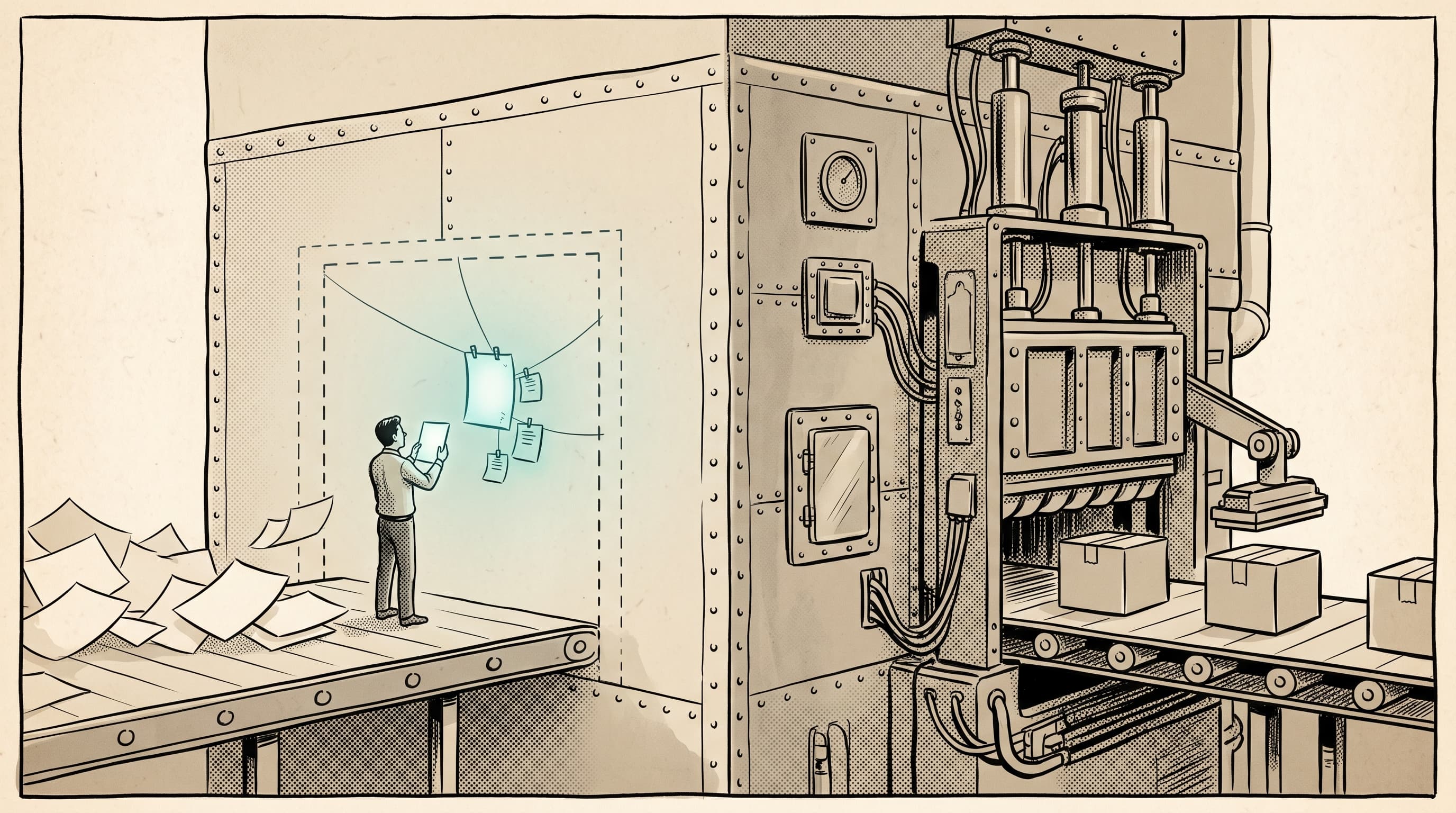
The factory moved upstream
The software-factory metaphor promises a repeatable path from an idea to a working system. Consider a workflow that interviews stakeholders, reads the existing architecture, drafts a specification, asks for approval, and checks the implementation before release.
That is a useful sequence. It makes requirements discussable and gives reviewers something more concrete than an instruction to “build the feature.”
It also creates a temptation: confusing a well-documented instruction with a well-founded product decision. The specification can be precise while an important choice remains unexamined.
Grounded in which reality?
Stakeholder interviews capture what people believe the product needs. System inspection can establish technical constraints. Customer research and behavior can challenge the explanation of the problem. These sources can all participate in the same workflow.
The question is what the review does with them. Does someone compare the proposed behavior with the original need? Do conflicting inputs become a decision to resolve, or does the first plausible answer simply become the specification?
Imagine an approved feature that ships as specified and goes unused. Implementation checks may have worked exactly as intended. The team still needs to investigate the product choice: whether the problem mattered, whether the proposed intervention helped, and what the observed result means for the next decision.
This is a risk to examine in any delivery process. It does not establish that a particular platform ignores users or that its reviewers cannot ask good product questions.
Extraction isn't judgment
Capturing an answer makes it available for review. Testing it against alternatives, constraints, and available evidence is further work.
Twelve support tickets may establish a recurring problem without proving that the proposed feature is the right intervention. An intake interview can ask about that distinction and surface competing explanations. The team still has to decide what to try and own the consequences.
The same is true when there are no research attachments. A founder's hypothesis can enter review as a hypothesis. Record what is assumed, why the experiment is worth trying, and what result would change the decision. Requiring a pile of sources before the first conversation would exclude useful work without making the eventual judgment sounder.
The question is whether an assumption can be challenged and whether someone will act when it is.
The review before the build
A useful review has two complementary parts.
The check makes gaps visible. Pathmode's deterministic preflight looks for signals such as an objective, observable outcomes, a constraint, a failure mode, and verification. These rules have limits. When text exists but the rules cannot confirm it, that is different from nothing being written. An unconfirmed result needs inspection; it is not proof that the author omitted a decision.
Our early calibration used 14 real specs and 98 labeled field examples. That work exposed how easily a rule can measure preferred phrasing instead of meaning. Those fixtures are a regression baseline, not evidence of accuracy on arbitrary customer documents. A passing result does not certify that a proposal is clear, complete, or right.
The person resolves the product choice. The engineer gives the existing request to the coding agent, which drafts a proposal. The product owner compares the interpretation with the request and product context. Evidence can help when it is available. A consequential question can come from any participant.
For example, “Let customers export their table” could become a proposal to export the current page. The owner asks whether the export should include every filtered result. The team resolves that scope choice, the agent revises the proposal, and the owner reviews and authorizes the exact revision before implementation. This is an illustrative example, not a measured Pathmode advantage over another planning workflow.
The correction and the authorization are separate. Asking the agent to change its interpretation does not mean the revised interpretation has already been accepted.
What the record establishes
Pathmode connects the original request, proposal, corrections, and signed-in authorization of a specific revision. The agreed decision can travel with the code in intent.md; private source material can remain outside Git.
That record tells the team which proposal was authorized. It does not establish that every claim was independently confirmed or that the chosen solution will succeed. Approval covers the proposal as a whole; it is not a collection of individual claim approvals.
Keep unresolved assumptions visible. An implementation finding can reopen a product choice, and a post-ship measurement can challenge the reason for making it. Checking the build and measuring the outcome answer different questions.
Make the extra review earn its place
The cost of another review matters. Some teams already resolve these choices effectively in their tickets, planning conversations, and pull requests. Others lose the product owner's correction between those steps.
Start with one real change. Compare the proposed behavior with the original request, resolve the consequential differences, and record the agreed revision. Then measure useful findings, unnecessary questions, decisions changed before implementation, and the time required. That is how to test whether a dedicated review improves the team's normal process.
The factory metaphor puts attention on how work moves toward production. Product judgment deserves attention before and after that movement: what the team chose, why it chose it, and what happened when users met the result.
The agent proposes. The team resolves the choice. The product owner authorizes the revised proposal.
Review the decision before the build.
Surface missing decisions and conflicts with your product context. Resolve them with your team, then hand your coding agent an agreed spec. Start with the request you already have; research attachments are optional.
Start with one product decision
One or two sentences is enough. Pathmode pushes back before anything is saved. No account needed to start.
Or paste a PRD, notes, or positioning page →·Have a live site? Scan it instead →