
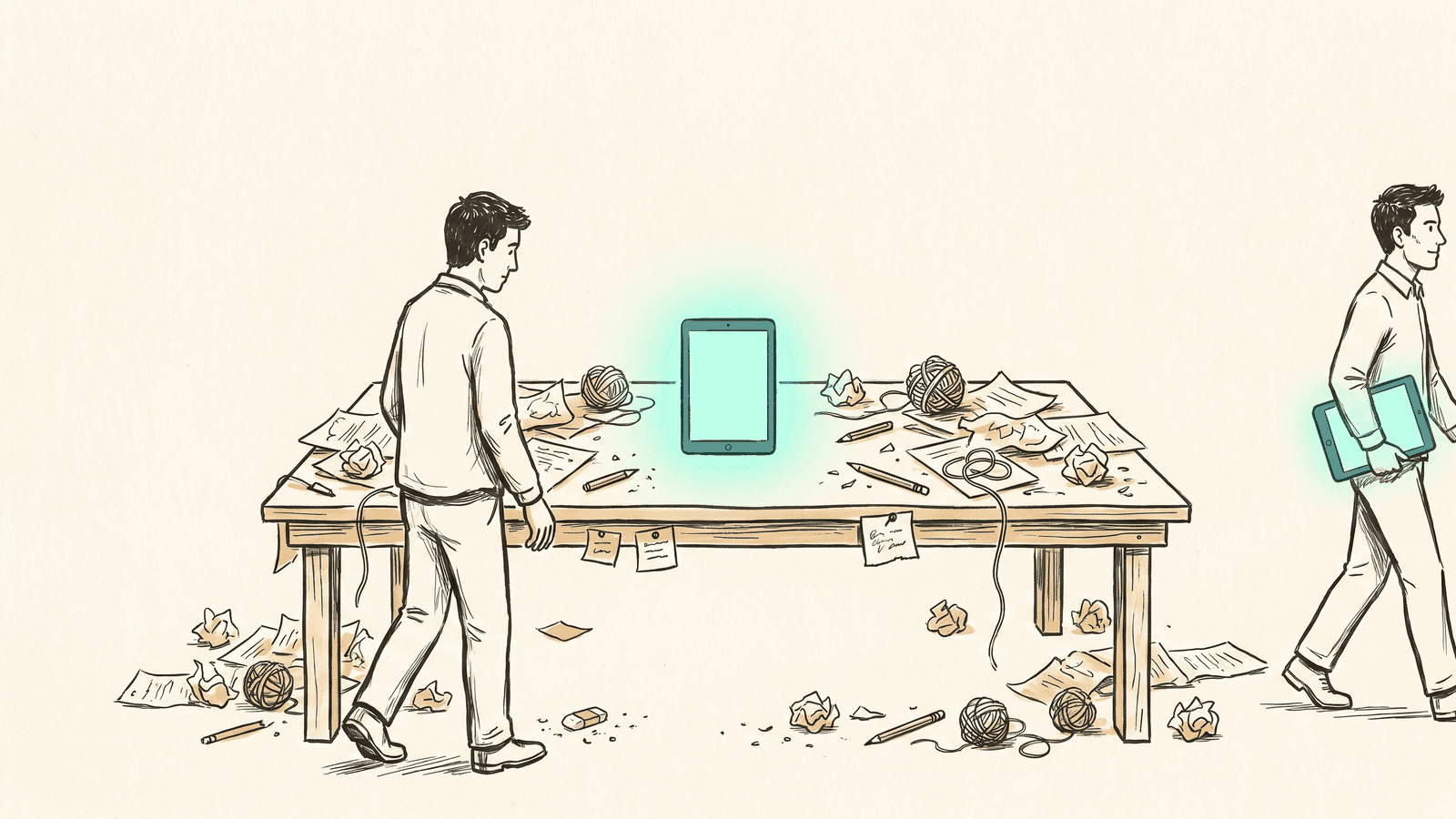
The best product managers, increasingly, look less like backlog managers and more like systems thinkers.
The job always had this shape. What's changing is that the shape is now visible. The backlog was the surface. The substance was always navigating policy intent, operational reality, legacy systems, procurement, organizational incentives, and the way humans actually behave when the design meets them.
The usual landing for this observation is that the hard part isn't shipping features — it's holding all of that at once — and that the work is deeply human.
That landing is true. It's also where the conversation stops too early.
The judgment is real. "Deeply human" is not wrong.
What's wrong is the assumption that judgment compounds by staying tacit.
It doesn't. The next decision down the line — the one made by someone who wasn't in the meeting, or made downstream by execution that has stopped pausing to ask — doesn't wait for the policy intent the PM never wrote down. It doesn't check in with the systems thinker before deciding which of three legacy systems to integrate against. It moves on whatever brief it can find.
The "deeply human" work isn't being protected by staying in heads. It's being bypassed by staying in heads.
Two teams. Both have a thoughtful PM doing real systems thinking.
Team A: the thinking lives in conversations, decks, a Slack thread that drifted off the top of the screen three weeks ago, the PM's intuition.
Team B: the thinking is externalized. Written down. Argued with. Anchored to the evidence that produced it. Legible to anyone who has to act on it next.
As execution gets faster, Team A's PM looks busier. Team B's PM is load-bearing.
The gap between the two widens as execution gets sharper, not narrower. Faster execution closes the transmission gap. It does not close the judgment gap. It makes the missing artifact more expensive.
Systems thinking has always needed a medium.
The whiteboard. The strategy doc. The two-hour meeting where the right people argued it out and walked out aligned. Those mediums worked because the people who needed the decision were the people in the room.
The medium has to change when the next decision down the line is being made by someone who wasn't in the room.
This is the part the "deeply human" framing skips. The judgment doesn't have to be replaced. The medium has to be upgraded — from a soft artifact that lived in human memory to a hard artifact that runs production.
A spec is one shape this artifact takes.
Not as a handoff document — that's the transmission-model version, and it doesn't survive contact with execution that no longer pauses. As residue. The thing left over after the systems thinker has argued with the problem, the evidence, the constraint, the failure mode. The conclusions anyone downstream can inherit without re-running the meeting.
The spec is not where the systems thinking happens. The spec is what proves the systems thinking happened.
The unease in "judgment is human, execution is everything else" isn't really about who does what.
It's that systems thinking has spent decades as a soft skill. Hard to teach, hard to evaluate, hard to scale, easy to lose when the senior PM leaves. The phrase deeply human gives the work dignity. It also gives it cover.
Invisibility was survivable when the next decision down the line was made by another human who'd been in the same building for two years. It isn't survivable when execution moves faster than the meeting that produced it.
The interesting move for PMs isn't to defend the systems thinking.
It's to externalize it. To stop treating the work as private cognition. To accept that the part of the job that was always the substance now has to leave the head.
"Deeply human" was shorthand for we couldn't write it down. That excuse is running out of road.
Systems thinking isn't deeply human work being protected. It's deeply human work that finally has a medium worth fossilizing into.