
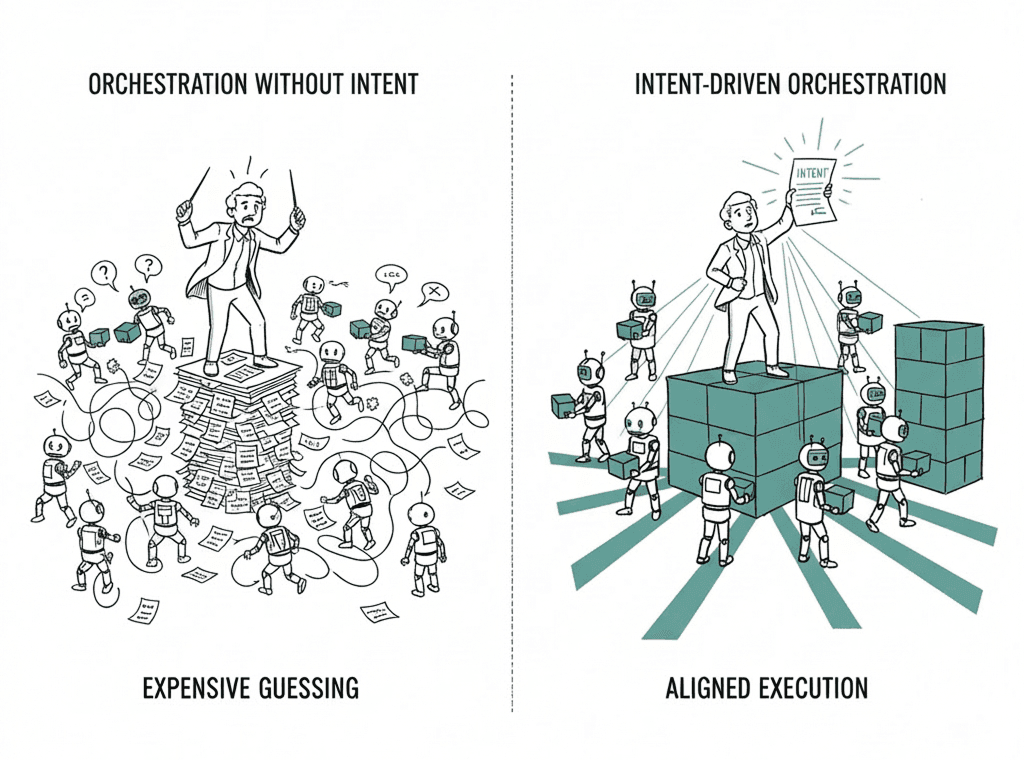
This article summarizes Anthropic's 2026 Agentic Coding Trends Report, then offers Pathmode's interpretation of what it means for product intent. The report presents predictions, supported by research and customer examples, rather than settled outcomes for the industry.
The Report's Eight Trends
In the report's order, Anthropic predicts:
- A changing development lifecycle: engineers spend more time directing and evaluating agents.
- Coordinated agent teams: multiple agents take on work together.
- Longer autonomous runs: agents tackle whole systems over extended sessions.
- More selective human oversight: automated review and escalation focus human attention.
- Broader access: agents reach more languages, interfaces, and users.
- Changing development economics: productivity gains make more projects viable.
- Adoption beyond engineering: business teams build tools for their own work.
- Security as a design priority: stronger defensive capabilities accompany greater offensive risk.
The report also cites Anthropic's internal research: engineers reported AI use in roughly 60% of their work, full delegation of 0–20% of tasks, and 27% of AI-assisted work that would otherwise not have happened. These are internal findings, not a representative industry survey. Its central emphasis is continued human judgment and validation. Read the report.
Pathmode's Take: Clear Intent Makes Delegation More Accountable
Our interpretation is that as teams delegate more implementation, they need a more durable record of what they authorized, why it matters, and how they will judge the result. That is the case for treating intent as infrastructure. It is Pathmode's argument, not an additional finding from Anthropic.
Engineering capacity still matters. So do model capability, access to the right tools, and the cost of verification. Clear intent addresses one part of that system: uncertainty about the problem, the desired outcome, and the boundaries of the work.
The Delegation Gap
The difference between frequent AI use and limited full delegation is useful to think of as a delegation gap. The figures alone don't explain its causes or establish how much of it a better spec can close.
For product teams, three parts of a handoff are worth making explicit:
Persistent context. A decision left in one conversation may never reach the next agent or developer. Record the problem, evidence, and reasoning somewhere the workflow deliberately retrieves.
Testable outcomes. "Build a checkout flow" is a request, not a specification. Without explicit success criteria, verification becomes guesswork.
Explicit constraints. Real features have boundaries: preserve the public API, use the existing payment provider, don't charge twice on retry. State the relevant limits instead of relying on an agent to infer them.
This is where intent engineering helps. An intent spec records the objective, outcomes, constraints, edge cases, and verification. It gives the agent a basis for action and the team a record against which to review the result.
More Possible Work Makes Prioritization Matter
The additional-work finding raises a practical question: when more projects become affordable, which ones deserve attention?
A cheaper implementation can still create maintenance costs or solve a problem nobody has. Before starting another agent run, identify the user friction, the evidence behind it, and the change you expect users to experience. Grounding the spec in evidence gives the team a reason to build and a way to reconsider the decision if the expected benefit doesn't appear.
Multi-Agent Systems Need Multi-Part Specs
When an orchestrator splits work across agents, each agent needs a clear scope: what it owns, what success looks like, and what it shouldn't touch. The shared spec should also identify dependencies and decisions that require human input.
Multi-agent systems can amplify the cost of ambiguity. An objective tells the orchestrator why. Outcomes tell each agent what done looks like. Constraints define boundaries. Edge cases give agents specific failure modes to handle and reviewers concrete scenarios to check.
| Handoff question | What the spec records |
|---|---|
| Why are we doing this? | The problem and supporting evidence |
| What does success look like? | Observable outcomes and verification checks |
| What may this agent change? | Scope, constraints, and dependencies |
| What could go wrong? | Known failure modes and expected behavior |
| When should the agent ask for help? | Decisions and discoveries requiring escalation |
A Concrete Handoff
Consider a hypothetical checkout task. The initial request is: "Fix checkout timeouts and add retry." That leaves the agent to decide what a timeout means, when retry is safe, and whether payment processing is in scope.
A clearer handoff would say:
- Problem: Customers lose confidence when payment remains pending without feedback and may submit again.
- Outcomes: Customers see a processing state while payment is pending. After a timeout, they can check payment status and see whether retry is available.
- Constraints and scope: Use the existing payment provider and preserve its idempotency protections. Work is limited to checkout status and recovery; pricing and order fulfillment are out of scope.
- Edge case: If payment succeeds but the response is lost, show the existing order after checking status; do not create a second charge.
- Verification: Simulate a delayed response, a lost response after success, and repeated clicks. Check both the customer-visible state and that only one charge exists.
- Escalation: If the existing API cannot establish payment status or support safe retry, report the limitation and request a decision before expanding scope.
This gives the agent room to solve the implementation while making the product decisions reviewable. A newly discovered limitation can still require a conversation.
The Longer the Run, the Higher the Stakes
An agent can spend hours implementing a coherent solution to the wrong problem. The cost includes reviewing what it built, discovering the mismatch, and deciding what to keep or redo.
Defining outcomes before a long run gives the agent and reviewer a shared reference. Checkpoints help catch mistaken assumptions before more work depends on them. Neither removes the need to inspect the implementation and test its behavior.
The practical lesson is to make the decision clear enough to begin, then revisit it when implementation reveals new information.
Everyone Becomes an Orchestrator
People outside engineering often understand the workflow and its failure modes better than the person implementing it. Structured intent specs give them a way to express that knowledge and judge whether the result meets their needs.
They still need appropriate technical review. A workflow can appear to work while mishandling permissions or exposing sensitive data. Product intent should make relevant boundaries explicit, with security checks and specialist review built into verification where needed.
What This Means for Your Team
For teams putting these ideas into practice, we recommend three changes:
Treat specs as infrastructure. Keep decisions persistent, structured, and versioned. Make reading the current spec and checking its authorization an explicit step in the agent workflow.
Ground decisions in evidence. Link the requested change to a real problem and an observable outcome. Use what you learn after shipping to judge whether the decision was sound.
Design for accountable delegation. Ask: can the agent proceed within clear boundaries, verify outcomes, and recognize when a decision needs human input? Clarification and escalation are part of a good handoff.
For Pathmode, the repository artifact is intent.md: the decision committed next to the code. Keeping it there makes it versionable alongside the implementation, but location alone does not ensure an agent reads or follows it. The workflow must deliberately retrieve it, check readiness before a long run, and verify the implementation against its outcomes before merge.
An agent-authored spec stays a proposal until a person authorizes it. If implementation uncovers a contradiction, that finding belongs back in the product record so the team can revise the decision. This gives delegation a record of what was agreed, what was built, and what still needs judgment.