
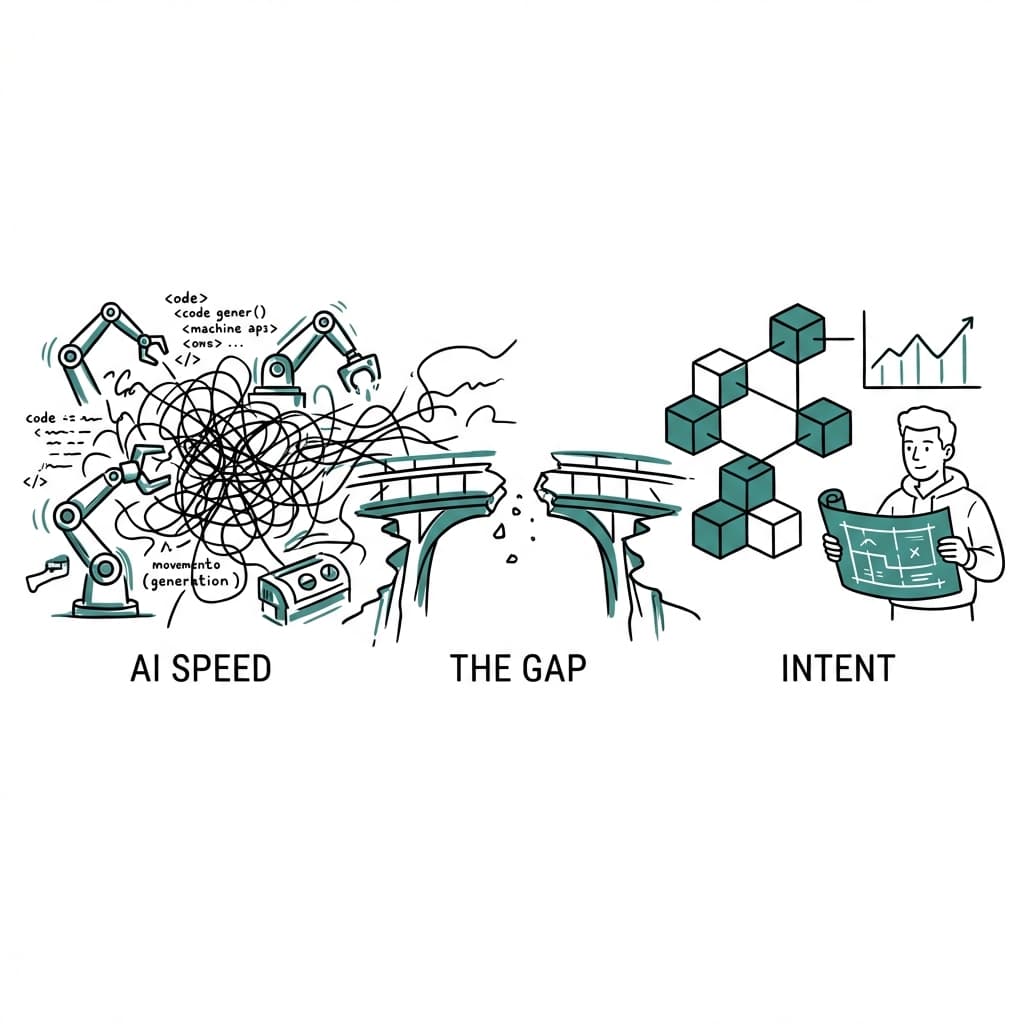
Every product team is being pushed to "use AI agents."
And they're all asking the same question: "What if we just give the agent access to our codebase and let it build features?"
What will happen is exactly that: you'll get code faster. You'll get pull requests faster. You'll get features shipped faster.
But speed has never been the thing holding product teams back.
The real bottleneck isn't code generation. It's definition.
Most teams already ship faster than they can validate. They build features, release them, and move on to the next ticket. The same problems resurface quarter after quarter—not because the code was wrong, but because nobody defined what "success" looked like before shipping.
Product breaks in the gap between idea → spec → build → verify.
AI Agents Don't Close That Gap
An AI agent can generate a component in seconds. It can write unit tests. It can even deploy.
But it cannot, on its own:
- Define intent: What is the user actually trying to accomplish, and why does it matter?
- Articulate outcomes: What are the observable changes in the world that prove this worked?
- Identify edge cases: What happens when the user has spotty internet, or zero data, or a legacy account?
- Track success: Did this shipped feature actually solve the problem, or did we just ship it?
- Preserve memory: Why did we build this? What did we learn?
That requires a system, not a model.
This is why the first wave of AI coding tools improved developer productivity, but not necessarily product outcomes. We got more code, but not better products.
AI agents risk repeating the same pattern: faster code, same failure rate.
The Missing Link: Intent
Intentional product development requires discipline that models don't have out of the box:
- A clear definition of success before code is written.
- Observable outcomes that can be verified.
- Explicit constraints that agents must respect.
- Continuous tracking of whether shipped work actually moved the needle.
AI can help you build faster. It cannot replace the discipline required to build right.
And "right" requires explicit, structured intent—otherwise teams ship features that feel productive but change nothing.
The Missing Piece
The answer isn't smarter agents. It's better specs.
Before an agent touches a line of code, someone needs to answer: "What does success look like, and how will we prove it?"
That question—forced into a structured format with explicit objectives, constraints, outcomes, and verification criteria—is what separates code that ships from code that sticks.
AI is part of the equation. It's just not the equation.
Product teams don't need faster code. They need clarity on what to build—and proof that it worked.